


Contemporary art today appears obsessed with bigger is better. Academic training encourages emerging artists to express themselves in large format painting and sculptural compositions. Colour, form and movement infatuates, mesmerises, fascinates and hypnotises our consciousness. Artists are well aware of the power of aesthetic allure, however it also can gloss over, pretend, promise and lie. The obsession with the visual also shows in the preoccupation of our culture to quantify and commodify everything. In the end it remains a special effect.
Few artists, especially painters, create small-scale compositions that deliver the essential wow qualities that capture our senses and leave us awe-stricken by their technical prowess, as large-scale works can. Yogyakarta-based Afghan artist Amin Taasha’s miniature paintings are charismatic and compelling. A potent merging of Asian cultural influences with contemporary art ideas, his 2024-2026 watercolour and gouache paintings on paper, accented with gold and silver leafing, immediately command our attention.
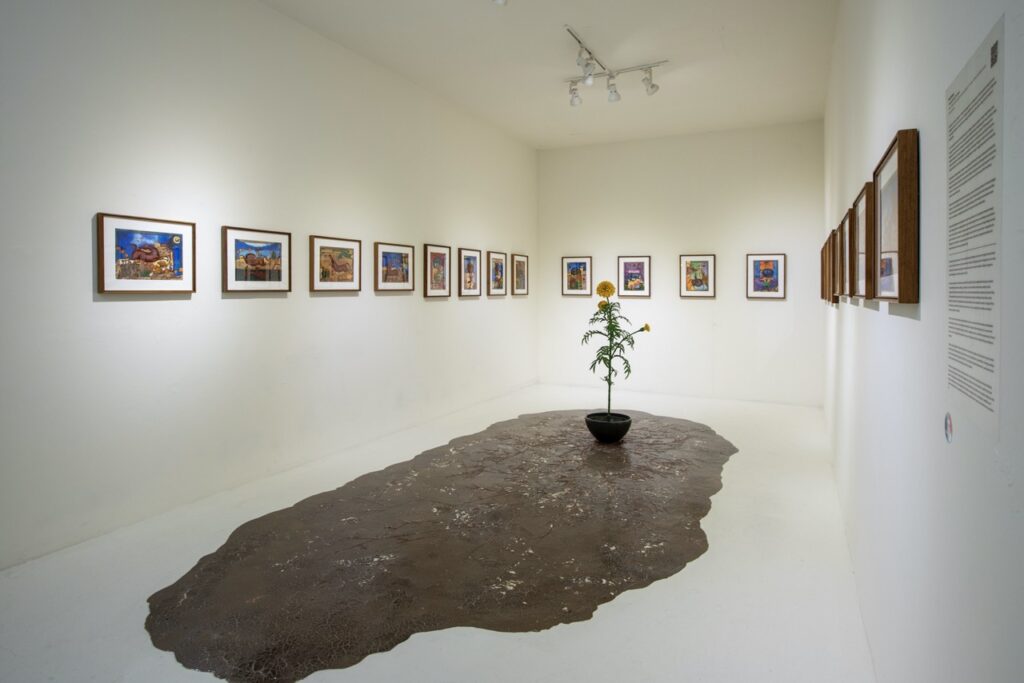
‘The Long Exhale of the World’ (2024–2026) presents twenty 28 by 36 cm paintings, along with a central floor installation of blooming Marigold flowers within a field of parched earth. It is one of the most aesthetically and technically outstanding artworks at ARTJOG 2026 ARS LONGGA at the Jogja National Museum (JNM), open 19 June–30 August 2026.
In ‘The Long Exhale of the World ’, the mythological collides with the tangible, perceptible world. Layered compositions fuse pictorial styles, bringing the artist’s ideas to life while igniting the observer’s imagination. Abstraction intersects with realistic and naïve descriptions. In encounters with dualistic forces, demons are juxtaposed alongside the series’ focal icon: the horse. Taasha’s mindscapes invite viewers to reflect on their own journey and discover their own meanings within the work.
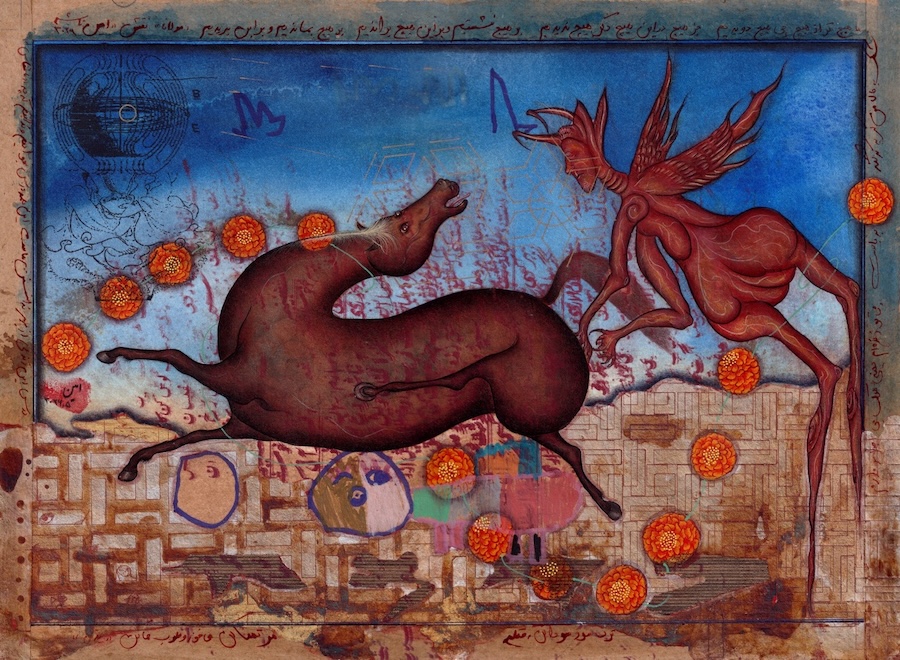
“Framed” individual compositional structures are pieced together as configurations of small descriptive scenes. Landscape elements fuse with Persian script. Military helicopters and machine guns loom omnipotent in the sky. Plains of contrasting colour add visual tension. Marigold flowers seem to float across the compositions. Unexpected imagery is arranged side by side, increasing the pictorial drama. Naïve child-like figures offer satirical, light-hearted respite.
“My paintings explore the tension between light and darkness, the conscious and the unconscious, the known and the unknown,” Amin Taasha told NOW!Jakarta Magazine. “The shadow represents the part of ourselves that each of us must eventually face, understand, and learn to live with. It is not necessarily something to defeat, but something to acknowledge and accept.”
“The horse is a symbol of the individual who embodies endurance, instinct, freedom, and the will to survive. It represents anyone who continues moving through life despite uncertainty, fear, or inner conflict. The unknown creatures are manifestations of our hidden emotions, fears, memories, and unresolved experiences. Sometimes they confront the horse directly, and other times they simply exist alongside it, reminding us that these forces are always present. The narrative is both personal and universal.”
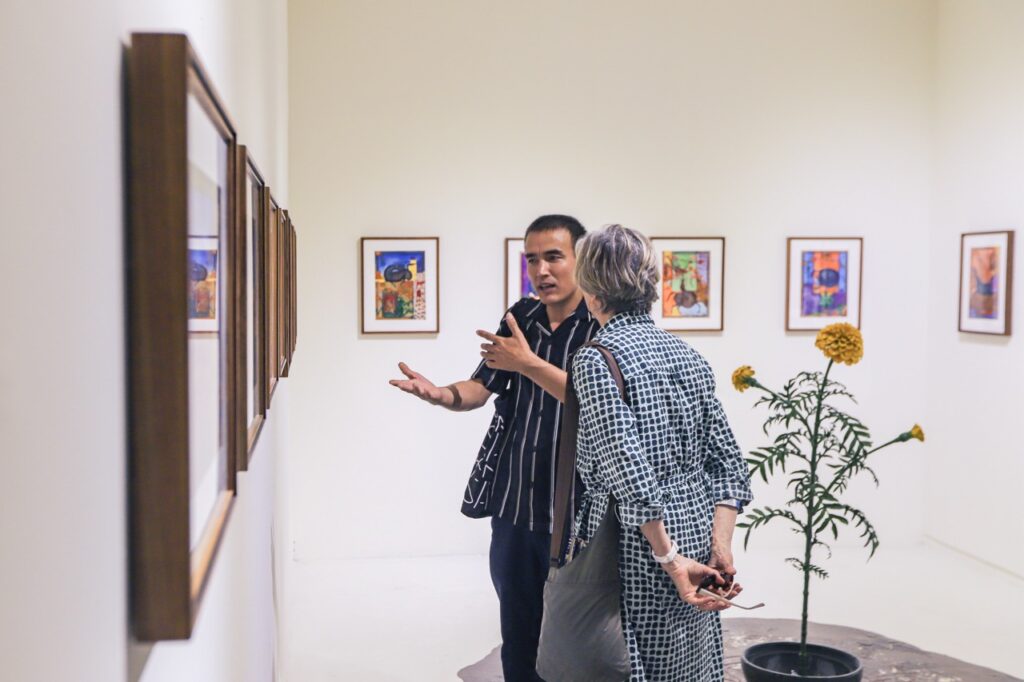
Born in 1995 in the mountainous Bamiyan Province, central Afghanistan, Taasha’s style draws upon a wealth of Persian traditional miniature art, combining aspects of Greek and Buddhist art into a unique classical style known as Greco-Buddhist/gandahara art. These recent works take inspiration from the celebrated Persian poet Hafiz Shirazi (1325-1390). Through his works, he reflects on the human condition and the struggles experienced by Hafiz.
“In 2008, I developed a basic understanding of the history of Persian miniature painting. In 2009, I participated in a wasli paper-making workshop (wasli is a traditional, multi-layered handmade paper developed in India in the 10th century specifically for miniature painting and calligraphy) and an introductory miniature painting workshop; several were led by Pakistani/Afghan artist Khadim Ali. And I also participated in his contemporary art workshops, shaping my early artistic development,” Taasha says. The couple were reunited again in 2013 during The Seeing Study Documenta 13 international art project in Kabul. Ali became one of Taasha’s earliest sources of inspiration, influencing his decision to pursue a fine arts career.
In 2013, Taasha relocated from Afghanistan to Central Java, where he was awarded a one-year scholarship at UNNES Semarang. In 2014, he received a bachelor’s scholarship to study Fine Arts at the Indonesian Institute of the Arts (ISI) Yogyakarta, graduating in 2018. After graduation, he returned to Afghanistan several times before settling permanently in Yogyakarta in 2019, where he has since lived and developed his artistic practice.
“In 2019, we met again during one of Ali’s visits to Yogyakarta and I studied more deeply under his guidance. Since then, I have continued to learn, practice, and deepen my understanding of Persian miniature painting,” says Taasha, who is now responsible for a new direction in Asian contemporary art.
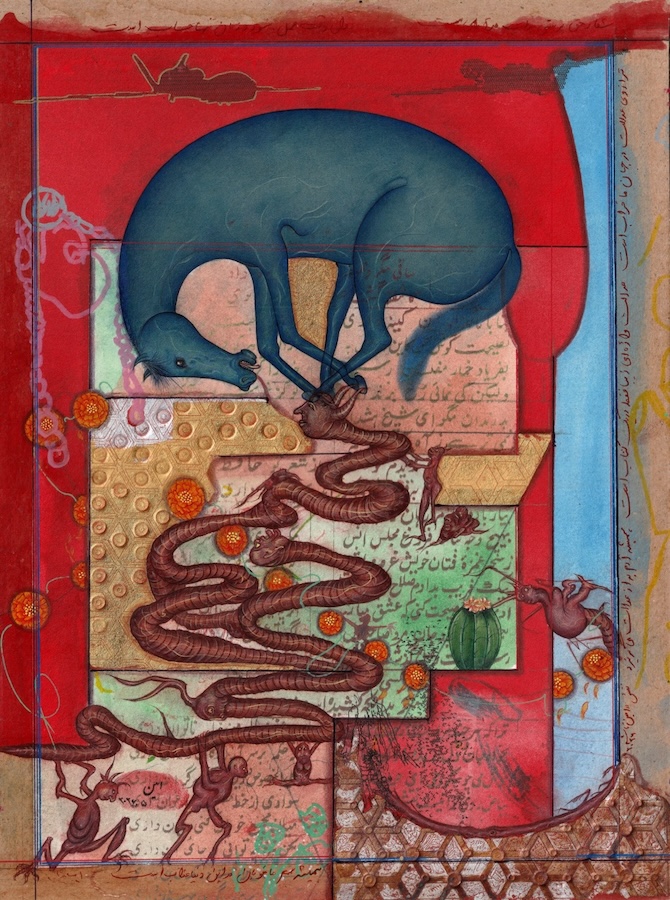
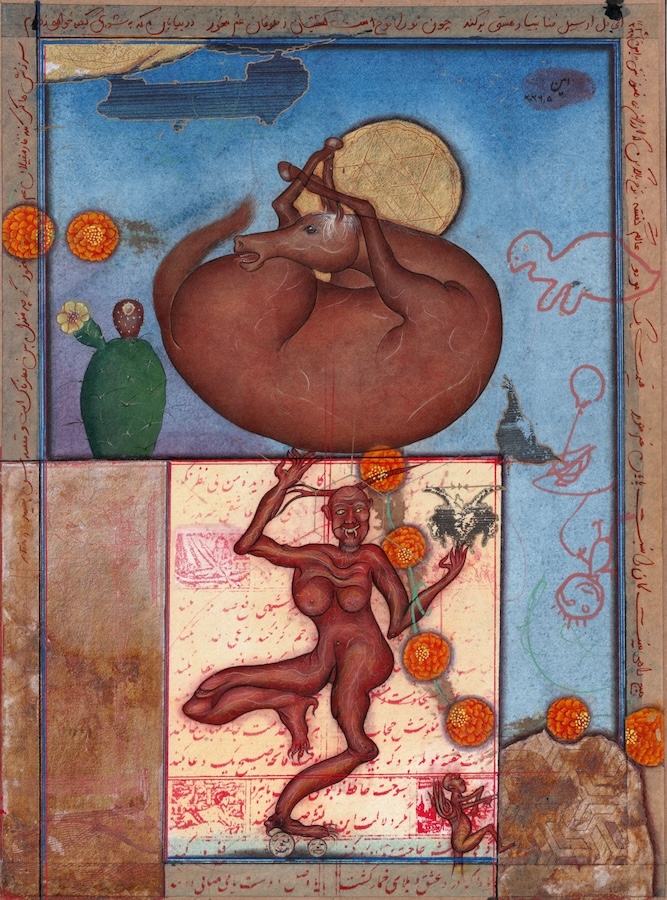
Since Taasha’s premier solo exhibition in Indonesia, “Iron Cocoon’ in 2018, his style has evolved. His narratives have become more personal rather than descriptions of his country’s dramatic past. Black is no longer a predominant visual feature. His iconography is reduced; gone are Buddhist descriptions, figures derived from the 7th–11th–century Afghan miniature painting style and Chinese ink-modified calligraphy.
Taasha has been exhibiting consistently for the past 20 years domestically and internationally in notable venues, including ARTJOG 2026 ARS LONGGA at the Jogja National Museum, “Voice Against Reason” at Museum MACAN in Jakarta, 2023-2024 and the 10th Asia Pacific Triennial of Contemporary Art (APT10), 2021-2022, at QAGOMA in Brisbane, Australia. His artwork has also been featured at Richard Koh Fine Art in Kuala Lumpur, the Auckland Art Fair in New Zealand, and various exhibitions in Afghanistan, Australia, Canada, France, Germany, Indonesia, Iran, Italy, Japan, Malaysia, Lebanon, and the US among others.
His most recent solo exhibition, “Seeing Beyond,” was held in Kuala Lumpur, Malaysia, in April/May of this year. His works are in collections in the UK, US, Canada, Netherlands, Germany, France, India, Australia, Singapore, Malaysia and Indonesia.
“The symbols within ‘The Long Exhale of the World’ represent the things that shape our lives, what we learn, see, hear, and the experiences we carry with us. Rather than portraying a battle where one side wins, I am interested in the possibility of coexistence, acceptance, and transformation.”
Follow the artist on Instagram here: @amintaasha