



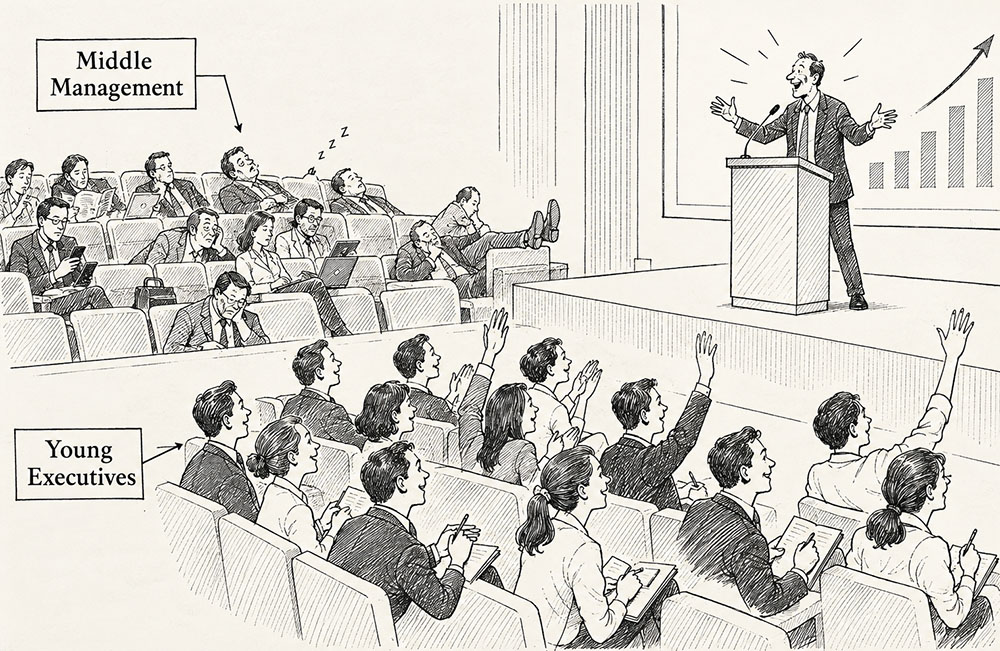
I was standing at the back of a conference room in Jakarta, facilitating a strategy rollout for a multi-generational family business in distribution. The CEO was on stage, blazing through a 60-slide deck with the intensity of a man who had found religion. Digital-first supply chain. AI-powered logistics. New market verticals.
In the front rows, the junior team was electric. Nodding. Scribbling. Slacking each other fire emojis. But I wasn’t watching the front rows. I was watching the middle.
Three rows back, a cluster of mid-level leaders sat in near-perfect stillness. Arms folded. Faces neutral. One was staring at the ceiling. A regional operations head with over 15 years in the company had an expression I’ve come to recognise instantly: the quiet, resigned look of someone who knows exactly how this ends. Not with transformation. With a slow return to normal, plus a new acronym nobody asked for.
His face didn’t say “this is wrong.” It said something worse: “This is impossible to execute. And nobody is going to ask me why.”
That room – CEO on fire, juniors on board, middle managers frozen – is the single most common scene in Indonesian corporate life. And it is where most transformation efforts quietly go to die.
The Layer That Runs the Country (And Gets Nothing for It)
According to Gallup’s 2025 State of the Global Workplace report, managers account for 70 percent of the variance in team engagement. Not strategy. Not technology. Not the CEO’s vision statement. Managers. They are the transmission layer of every organisation, translating strategy into action, absorbing pressure from above, shielding teams below, carrying the institutional memory no onboarding document could ever capture.
And they are being destroyed. Gallup reports that 45 percent of middle managers are now experiencing burnout, higher than any other employee group. Simon Sinek’s Optimism Company found 75 percent of managers report extreme burnout and disconnection, with one in four actively planning to leave. The average middle manager now oversees 12.1 direct reports, a 50 percent increase since 2013. And only 44 percent have ever received formal management training. More than half of the people executing your transformation strategy have never been taught how to manage.
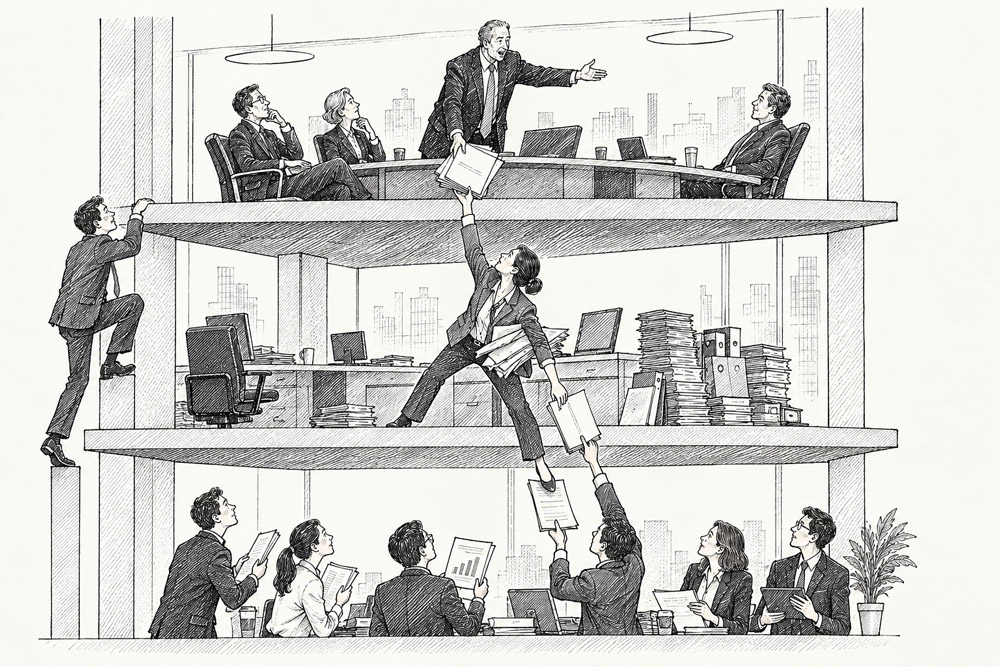
In Indonesia, this crisis is amplified by what I’ve called the “Bapakism” Bottleneck in previous columns – the cultural dynamic where every decision flows upward. Middle managers cannot act without approval from above and cannot push back without risking feeling ‘malu’ or embarassed. But the squeeze comes from below, too. Indonesia’s younger workforce shows up expecting flat hierarchies and open dialogue, and they find a middle manager who can’t give them any of that, because they don’t have it either. The result is a leadership layer simultaneously responsible for everything and authorised to decide nothing.
The Strategic Checkout
What happens next is not dramatic. There is no confrontation nor resignation letter. There is something far more corrosive: the Silent Withdrawal. They show up. They attend the meetings. They fill out the KPI spreadsheets. They nod at the right moments. But mentally and emotionally, they have checked out. Physically present. Strategically absent.
I’ve seen this across every market I work in — Jakarta, Hong Kong, Sydney. In Australia and Hong Kong, middle managers have told me point-blank: “I know this strategy won’t work, but I’ve got school fees and a mortgage that won’t wait for me to find my purpose.” In Indonesia, the calculus is the same with an added cultural layer. Leaving isn’t just a financial risk, it’s also a social one. Walking away from a prestigious company name carries a stigma that touches family, community and gengsi (pride). So they stay and they slowly freeze.
This is the “Asal Bapak Senang” feedback loop at its most insidious. The CEO gets sanitised progress reports. The board gets green dashboards. Everyone smiles. And the transformation dies not with a bang, but with a beautifully formatted quarterly review.
I’ve Been in That Middle
I know this dynamic because I’ve lived inside it. At the largest gold mine in the Southern hemisphere, I wasn’t always leading the charge. There were moments when I was the one sitting in the middle, watching the gap between what leadership said and what happened on the ground. Diversity and Inclusion was a stated priority. The values were on the walls. But what I saw on the floor was surface-level polish. Greenwashing in a hard hat.
The people who could see that gap most clearly? The middle layer. We knew. We all knew. But the system didn’t have a mechanism for that knowledge to travel upward without being filtered, softened, or dismissed. So, it stayed in the corridors, in the car park after meetings, in conversations that would never make it into the minutes.
That’s why the most effective transformation I’ve been part of took a radically different approach. At SMEC, the global engineering firm behind some of the world’s largest infrastructure projects, we brought the top 200 leaders into the strategy process as participants, not as audience. Then we engaged 15 percent of the entire workforce for real, unfiltered data on what people actually thought and felt about the strategy. The result was sharper, more grounded, and – crucially – the middle layer had fingerprints on it. The shift from “execute what we’ve decided” to “help us decide what to execute” changed everything. When the middle is frozen, it’s almost never because they lack capability. It’s because they lack voice.
Three Questions for the C-Suite
If your transformation isn’t landing, stop looking at the strategy deck. Start looking at the middle.
When was the last time you asked a middle manager what they actually think? Not in a town hall. Not through an engagement survey. In a conversation where they genuinely believed honesty would not be punished.
Are you measuring them on change or on stability? You cannot ask for both and punish the person who fails at either. If transformation is an addition to their load rather than a redesign of it, you haven’t empowered them. You’ve burdened them.
Who gets the credit when change works? If the CEO takes the stage and the middle manager returns to their KPI spreadsheet, you’ve taught every other middle manager exactly what their role is: invisible labour. And invisible labour eventually stops labouring.
The Bottom Line
Indonesia’s economy runs on the backs of its middle managers. They open the warehouses, run the regional offices, and manage the client relationships that keep revenue flowing. And we are losing them – not to competitors, but to indifference. To the slow realisation that their effort doesn’t shape outcomes, their voice doesn’t reach decisions, and their loyalty is rewarded with more responsibility and less authority.
The frozen middle is not a people problem. It is a design problem. The thaw starts when the C-suite stops talking and starts listening – not to consultants, not to the board, but to the people three rows back, with their arms folded and their mouths shut, who already know exactly what’s wrong.