



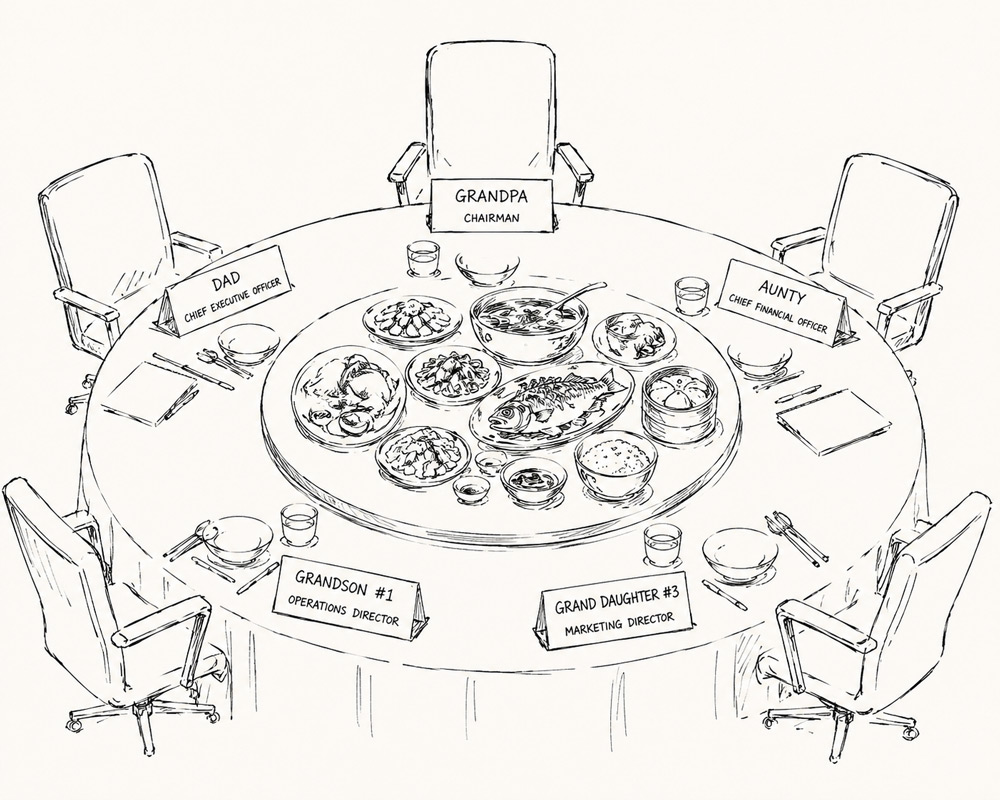
Here is something that nobody in a wealthy Indonesian family will say at the dinner table: the business that made us rich might not survive us.
They’ll say it in private, of course. Over a quiet coffee in Singapore with a wealth advisor. In a whispered aside to a trusted non-family executive. But never during makan bersama on a Sunday, when the patriarch is holding court at the head of the table, the same table where he has been making every major decision for the past 40 years.
And therein lies the problem.
Family businesses make up roughly 95 percent of all businesses in Indonesia and contribute an outsized share of the country’s GDP. They are the backbone of the economy, from the conglomerates that dominate the Jakarta Stock Exchange to the mid-sized manufacturing firms in Surabaya and the trading houses in Medan. But here’s the worst-kept secret in Indonesian business: the vast majority of these companies have no credible plan for what happens when the founder steps aside. Or dies. Or simply refuses to let go.
According to PwC’s most recent Global Family Business Survey, 43 percent of Indonesian next-generation leaders cite resistance from seniors as the single biggest barrier to leadership transition. That figure is nearly double the global average. And only 13 percent of large Indonesian family businesses have what could be described as a formalised, communicated succession plan.
The math is brutal: the first generation builds the empire. The second generation manages it. The third generation loses it. In Indonesia, that proverb isn’t just a cautionary tale. It’s a statistical probability.
When Bapak Is Literally Bapak
In my previous column for NOW! Jakarta (May-June 2026 Edition), I’ve written about the “Bapakism” Bottleneck — the way Indonesia’s high power-distance culture creates organisations where every decision funnels upward to the person at the top, whether or not that person has the best information. In corporate Indonesia, this dynamic slows things down. In family businesses, it is exponentially worse. Because in a family business, Bapak isn’t just a metaphor for the boss. He is literally your father.
Try telling your father that his flagship product line is haemorrhaging market share. Try explaining to your mother that the CFO she personally hired from the arisan circle is cooking the books. Try suggesting to the uncle who built the factory with his bare hands that it’s time to shut it down and pivot to digital.
You can’t. Or rather, you won’t. Because in Indonesian family culture, disagreement with an elder isn’t just a professional risk — it’s a moral transgression. The “Asal Bapak Senang” feedback loop I’ve described in corporate settings becomes, in the family business, something far more personal: Asal Keluarga Harmonis. As long as the family appears harmonious, nobody rocks the boat. Even when the boat is heading straight for the rocks.
The result is a leadership vacuum disguised as loyalty. The next generation sits in the waiting room — sometimes for decades — holding titles that sound impressive on a business card but carry no real authority. Vice President Director. Commissioner. “Special Advisor to the Chairman.” All of which translates to the same thing: stand by, your turn will come. Maybe.
The Dinner Table vs. The Boardroom
I’ve worked with family-run organisations across Asia-Pacific — in mining, FMCG, and hotels. It is always the same: the family operates on one logic (loyalty, harmony, seniority) while the market operates on another (speed, competence, adaptability). When these two logics collide, the family logic almost always wins. Not because it’s better, but because it’s older and more emotionally entrenched.
Here is what that collision looks like in practice:
The eldest son is appointed CEO not because he is the most capable sibling, but because he is the eldest son. The daughter who spent a decade at McKinsey in Singapore is offered a “supporting role” because the family doesn’t believe a woman should lead the group. The nephew who ran a successful tech startup is sidelined because he married outside the ethnic group. The professional CEO brought in to modernise the company lasts 18 months before being quietly replaced by a family member because he made decisions the patriarch didn’t approve of.
None of this is theoretical. I’ve watched every one of these scenarios play out. And every time, the justification is the same: “You don’t understand. This is family.”
That’s exactly the problem. Nobody is arguing that family doesn’t matter. But when “family” becomes the answer to every strategic question, it stops being a consideration and starts being a cage. The companies that survive generational transition are the ones that learn to separate the dinner table from the boardroom. Not by abandoning family values, but by building governance structures that prevent love and loyalty from overriding logic.
The Ones Who Got It Right
Not every Indonesian family dynasty implodes. Some navigate the transition with remarkable discipline.
Consider the Salim Group. Founded by Sudono Salim, the group survived the 1998 crisis, the seizure of Bank Central Asia by government regulators, and the kind of political upheaval that would have buried a lesser enterprise. Today, under second-generation leader Anthoni Salim, the group still runs Indofood, the world’s largest instant noodle producer, along with Indomaret’s vast network of over 22,000 convenience stores. But the more interesting story is the third generation. Axton Salim, Anthoni’s son, didn’t walk into the corner office. He joined an Indofood affiliate, worked his way through operations, and earned his credibility by launching new product lines and engaging Indonesia’s younger consumer base. He was given responsibility, not a title. The succession wasn’t gifted. It was earned.
The Hartono family behind the Djarum Group offers a different but equally instructive lesson. When the founder passed and the factory burned down in 1963, sons Robert Budi and Michael Bambang Hartono didn’t just rebuild the cigarette business — they reimagined the entire portfolio. Their acquisition of Bank Central Asia during the Asian Financial Crisis was one of the shrewdest moves in Indonesian corporate history. And when the third generation arrived, Martin Hartono didn’t try to replicate his father’s playbook. He built GDP Venture and invested in Blibli, Kaskus, and Indonesia’s emerging digital economy. The Hartonos gave their next generation permission to build something new rather than forcing them to maintain something old.
Then there are the cautionary tales. Such as one of Indonesia’s richest family enterprises who were valued by Forbes at $5.4 billion in 2007, but by 2012 had fallen off of Forbes’ list entirely. Over-leveraged assets, an infamous ‘mud disaster’, and a similarly infamous partnership with a Rothschild saw the end of the group’s glory days. Underneath the financial drama was a deeper structural failure: concentrated authority, opaque governance, a business strategy inseparable from political ambition. Importantly,the feedback loops that might have signalled danger were either absent or ignored.

The Middle Layer Problem
In my first column for NOW! Jakarta, I argued that most corporate change initiatives fail because “the C-suite is inspired, the juniors are excited, and the middle management is terrified.” In family businesses, the same dynamic exists — but the “middle” isn’t middle management. It’s the eldest son who’s been waiting 20 years for his turn. It’s the daughter-in-law who was never given a real seat at the table. It’s the sibling who runs a profitable division but can’t make a capital decision without calling the family patriarch first.
This middle layer is where succession goes to die. They carry the operational knowledge but lack the authority. They see the market shifting but can’t act on it. They are, in many cases, the most qualified people in the entire organization, but simultaneously the most constrained.
What makes this uniquely painful in Indonesia is the cultural expectation of sabar — patience. The next generation is told to wait, to learn, to earn their stripes. And much of that counsel is genuinely wise. But there is a difference between patience as preparation and patience as a stalling tactic. When “wait your turn” really means “I’m not ready to let go,” patience stops being a virtue and becomes a form of institutional paralysis.
A Framework for Families That Want to Survive
If you are sitting inside a family business today, whether as a founder, a successor, or a non-family executive trying to navigate the politics — there are three questions worth asking:
Are you choosing your successor, or choosing your mirror? Research on Indonesian family businesses reveals a strong tendency toward what academics call “homosocial reproduction” — incumbents selecting successors who reflect their own image. The founder picks the child who thinks like him, acts like him, and agrees with him. But the market your successor will face is not the market you built the company in. The best successor might be the one who argues with you the most.
Have you separated governance from emotion? The families that survive transitions have one thing in common: clear structures that govern how business decisions are made, independent of family relationships. Family councils. Independent boards with real authority. Formalised entry criteria for family members joining the business. If the only qualification for a C-suite role is sharing a surname, the company is not being governed. It is being inherited.
Are you willing to let the next generation build, not just maintain? The Hartonos understood this. The Salims are learning it. The most successful transitions happen when the next generation is given license to create new value, not just preserve old value. This means tolerating experiments that might fail. It means allowing the next generation to enter markets the founder doesn’t understand. It means, sometimes, stepping back and accepting that the future of the business might look nothing like its past.
The Bottom Line
Indonesia’s family businesses are not just commercial enterprises. They are repositories of identity, sacrifice, and generational ambition. Nobody — not the founder, not the successor, not the consultant standing on the sidelines — should treat that legacy lightly.
But legacy is not a preservation exercise. It is a living thing that must be adapted, challenged, and sometimes entirely reimagined. The founder who refuses to plan for succession isn’t protecting the legacy. They are gambling with it. And the next-generation leader who silently accepts a ceremonial title while the market shifts underneath them isn’t being respectful. They are being complicit.
The families that thrive in the next decade will be the ones that ask the hardest question of all: Is this business being run for the family’s comfort, or for its future?
Because in the end, the market doesn’t care about your family tree. It only cares whether you can grow it.