


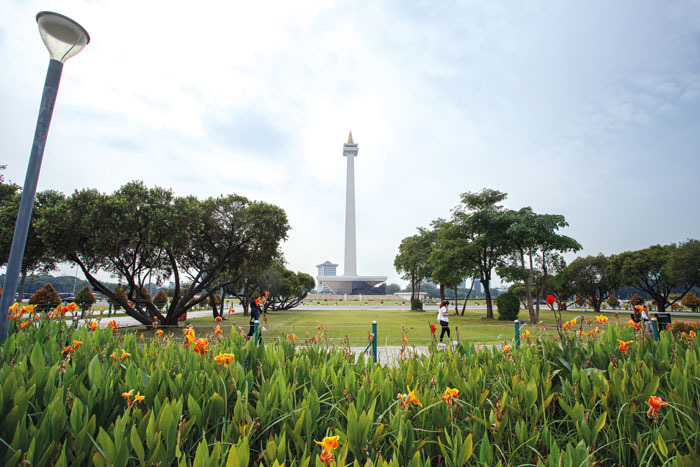
At the very heart of Jakarta lies Medan Merdeka, an expansive square that has witnessed the city’s transformation from colonial outpost to modern capital. Whilst the soaring National Monument (Monas) stands at its centre, the square predates the iconic structure and indeed Indonesia itself. This square has witnessed royal celebrations and military parades, early expressions of freedom to the very birth
of a nation.
Covering around 100 hectares of Central Jakarta, Medan Merdeka is the third largest city square in the world. An expansive plaza, embellished with monuments and gardens, enclosed within a one square kilometre perimetre, upon which the nation’s most important state institutions stand. There is a gravitas to the area, the weight of history and nationhood palpable when driving down the broad, tree-lined roads of this impressive civic landscape. But it wasn’t always like this…
It may be difficult to imagine, but the land upon which Medan Merdeka is today was once populated by wild boar, deer and buffalo. These were great plains, writes Adolf Heuken SJ in ‘Medan Merdeka –The Heart of the Capital of the Republic of Indonesia, where even tigers occasionally prowled. Its earthy clay soils were mined for brickmaking, and the resulting excavations became waterholes for herds of buffalo, giving rise to the name Buffelsveld, or ‘Buffalo Field.’ The earliest known reference to Buffelsveld appears in the Daghregister (Daily Register) of 1659, sharing how then Governor-General Joan Maetsuycker would journey into the ‘fields south of the Great Forest,’ to hunt for game.
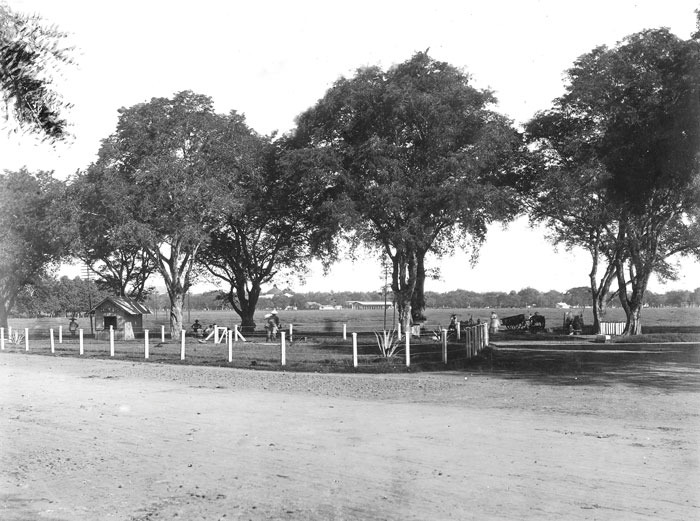
In the late 18th century, the Dutch colonial government decided it was pertinent to move the administrative centre: Oud Batavia – today’s Kota Tua – had become over-crowded and unsanitary, with the slow-moving canals silted and blocked (by an earthquake in 1699) causing major health problems for residents, including a major malaria outbreak of 1732. This catalysed plans to move further south to Weltevreden, the “very peaceful” estate first established by the wealthy merchant, Cornelis Chastelein. Slowly, the upper echelons of Dutch society and government migrated over to the greener pastures at Weltevreden, establishing an exclusive suburb of Rijswik. One building in particular remains a prime example of the period – Paleis te Rijswijk, built in 1796 by Jacon Andries van Braam, now Istana Negara, or the Presidential Palace.
Back to Medan Merdeka: It wasn’t until Governor-General Herman Willem Daendels took office in 1808 that the new administrative centre properly began its transformation. This was a major project, and the development of Weltevreden was done in phases. The old Buffelsveld was cleared to create a military exercise and parade field, which Daendels renamed ‘Champ de Mars’ in 1808; upon the previous parade grounds (Paradeplaats), Daendels began construction of a neoclassical administrative palace ‘Gouvernements Hôtel’, also nicknamed The Witte Huis (White House). He ordered the dismantling of the Batavia Castle and its walls, using the materials to begin construction of the new palace. Whilst construction began in 1809, the building wasn’t completed until 1828. Today, The Witte Huis is the headquarters for the Ministry of Finance, Gedung A.A. Maramis, named after Indonesia’s second minister of finance. In 1810, Daendels also began construction of Sociëteit de Harmonie, what would become Batavia’s most exclusive social club.
Daendels had grand plans for Weltevreden, he envisioned its wide boulevards, great plazas and squares, and suburban atmosphere. Much of this original scheme remains to this day. Yet, Daendals could never truly see his vision come to fruition. It was Lieutenant Governor Thomas Stamford Raffles who continued the developments of Weltevreden, overseeing the colony during the British Interregnum (1811-1816). He completed the construction of Sociëteit de Harmonie (1814) and continued civic expansion into the Weltevreden area, making it one of Batavia’s most prestigious residential districts.
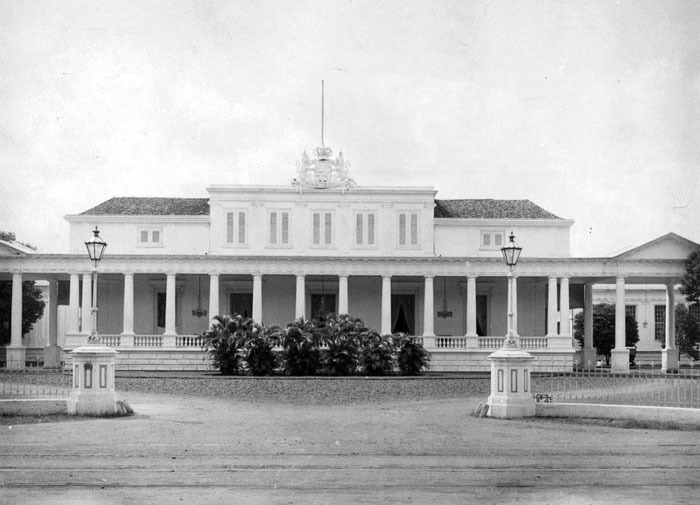
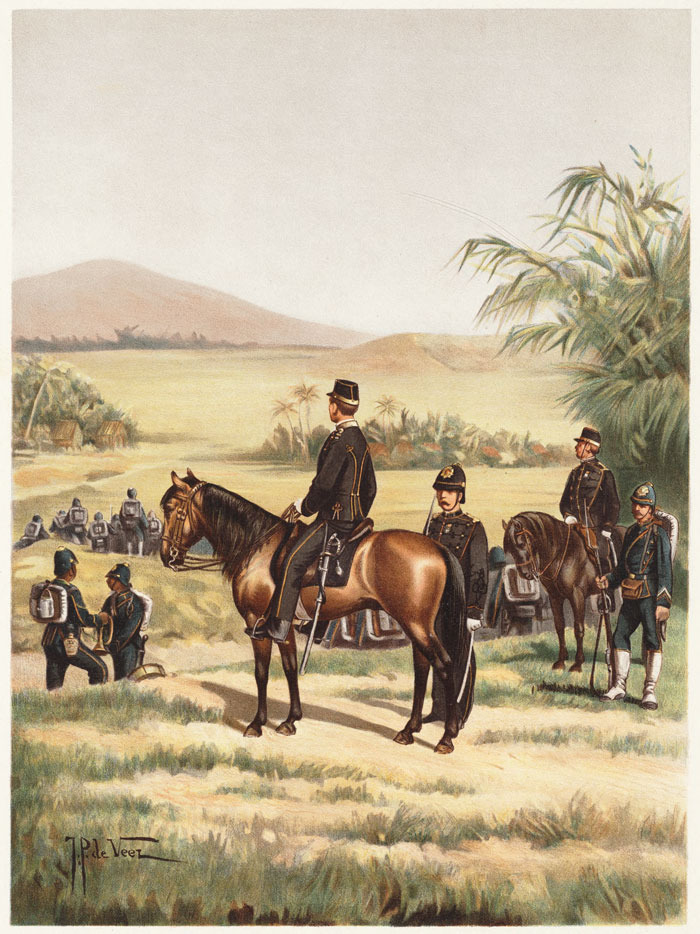
(Above) Rijswijk Palace. Batavia. Dutch East Indies (c. 1895). The historic name of the building now known as the State Palace (Istana Negara) in Jakarta; (Below-Left) A depiction of KNIL infantrymen in the Dutch East Indies, 1897, by J.P. de Veer and P.W. van de Weijer; (Below-Right) Lapangan Banteng was formerly known as Waterlooplein (Waterloo Square), while its earlier history as a buffalo field is reflected in its present-day Indonesian name, Lapangan Banteng (Photo by Des Syafrizal).
What’s fascinating from this period is how decisive moments across the world would later have their effects in Batavia. On 18 June 1815, Napoleon Bonaparte faced his final defeat at the Battle of Waterloo and the European powers duly reorganised states and colonies. The United Kingdom of Netherlands was born, and the British returned the Dutch East Indies to its former ‘owners.’
Under new Governors-general, Daendel’s squares were given brand new identities: Champ de Mars was renamed Koningsplein (King’s Square), honouring the new monarch, King William I; and Paradeplaats was renamed to Waterlooplein, in memory of the battle of Water Loo. These squares became the heart of life in colonial Batavia – the old town was abandoned to the Chinese merchants, as new residences and cultural buildings cemented the colonial identity. Major developments include the 1821 opening of a proper theatre, Schouwburg Weltevreden, now Gedung Kesenian Jakarta; Daendel’s‘Gouvernements Hôtel’ was completed in 1828, but was used as a high-level office instead of a residence; in 1830, the government erected Citadel Prins Frederik within Wilhelminapark, where today’s Istiqlal Mosque now stands.
However, Waterlooplein became a crowded and very institutional square, so in the later half of the 19th century Koningsplein began to see more cultural developments – these included the opening of the Museum of the Royal Batavian Society of Arts and Sciences (now National Museum of Indonesia, or Gedung Gajah) in 1868; the new Paleis te Koningsplein was opened in 1879 as the new residence for Governors-general (the old palace was ‘too cramped’), which is now Istana Merdeka. Finally, Station Weltevreden (now Gambir Station) was established in the 1880s, on the east fringe of Koningsplein, to ease access into what was easily Batavia’s most attractive area.
Despite all the colonial transformations, and Euro-centric titling of plazas and buildings, for the local population these squares had their own identity: Lapangan Gambir, a title believed to derive from the gambier trees that once flourished across the plains here. This name was acknowledged by the establishment of the Gambir Racecourse (Renbaan Koningsplein) on the southside of Koningsplein, and the first Pasar Gambir in 1906, a lively evening fair celebrating Queen Wilhelmina’s birthday – it became an annual tradition after 1921 and is regarded as the forerunner of today’s Jakarta Fair.
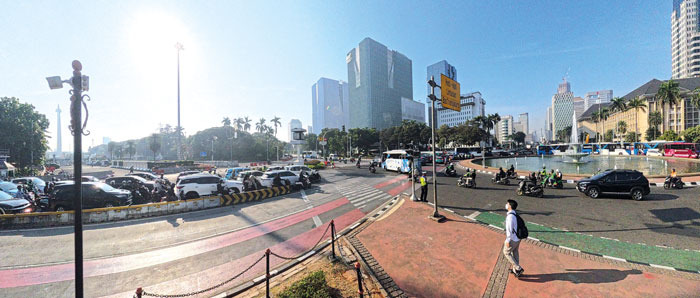
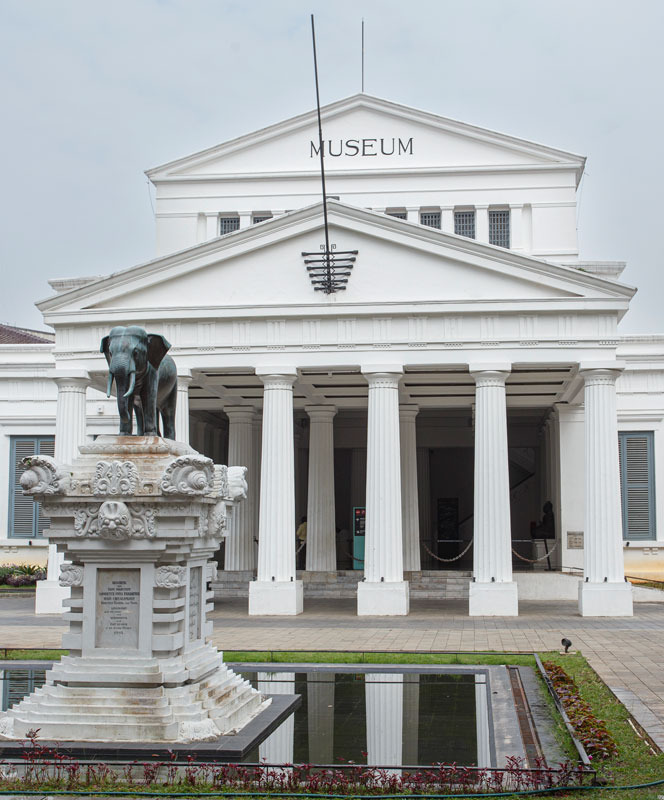
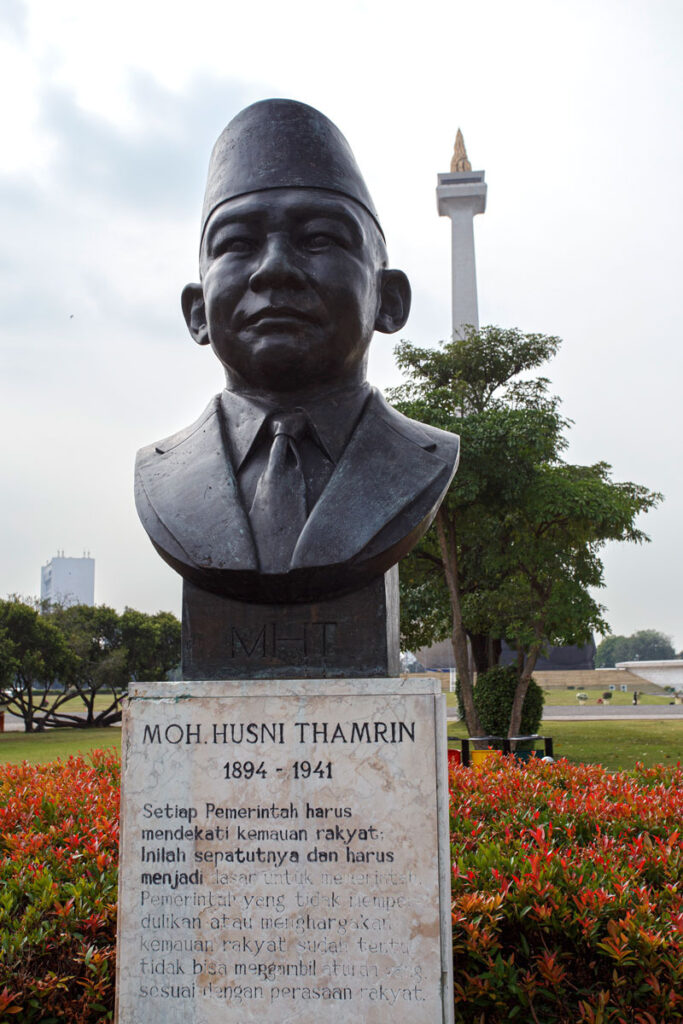
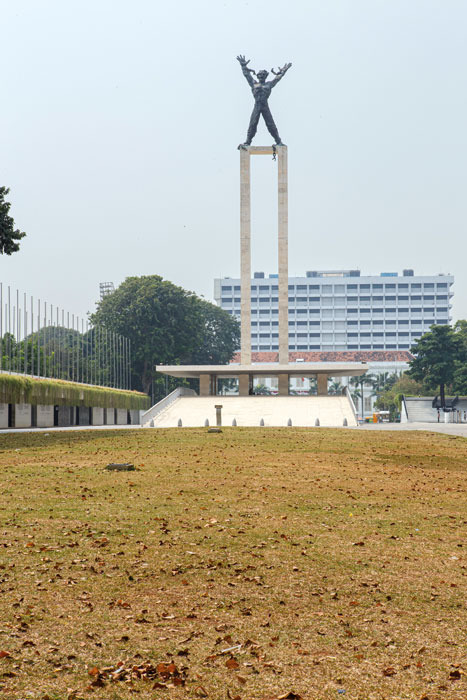
(Above) The present-day Medan Merdeka area leads towards Jalan M.H. Thamrin, bustling with traffic and urban activity; (Below-Left) National Museum; (Below-Right) National Monument with Moh. Husni Thamrin statue. Photos by Des Syafrizal.
A Colonial End, A Nation’s Beginning
The luxuries of Koningsplein and Waterlooplein came to an abrupt end during the Second World War, as Imperial Japan thundered into the East Indies in 1942, claiming the territory from the Dutch. Under Japanese occupation no colonial Dutch names were allowed – Batavia became ‘Djakarta Tokubetsu-shi’ (Djakarta Special Municipality), returning to the region’s name before Dutch rule. As such, Koningsplein was also renamed to Lapangan IKADA, after the Ikatan Ateletik Djakarta (Djakarta Athletics Association).
In 1945, the square was supposed to be the symbolic site for the public Proclamation of Indonesian Independence on 17 August, but security issues forced first President Soekarno to do some from his home on Jalan Pegangsaan Timur (now Jalan Proklamasi). A month later however, Lapangan IKADA would be the centre of a mass rally (estimated at 200,000 people) of those supporting the newly proclaimed Republic of Indonesia, despite the presence of Japanese armed forces. It was a defining moment in history.
In 1961, after independence was finally settled, President Soekarno sought to transform the new capital. He renamed the old Waterlooplein to Lapangan Banteng, a nod to its past as a ‘Buffalo’s Field’. As for the old Koningsplein, this would become Indonesia’s symbol of freedom: he razed old structures on the plaza, including the Gambir Racetrack, levelling the entire 10-hectare area. This became Medan Merdeka, ‘Freedom Square.’ On 17 August 1961, construction began for the square’s new centre piece, a towering obelisk that would forever be the nation’s reminder, Monas. The national monument was officially opened to the public on 12 July 1975, by successor President Soeharto.
From Paradeplaats to Waterlooplein then Lapangan Banteng; from Buffelsveld to Champ de Mars, to Koningsplein and Lapangan Ikada, finally becoming Medan Merdeka. These two squares are inseparable from Jakarta’s history – they have seen a city evolve around them, palaces raised, monuments erected, freedom fought for and freedom won. But importantly these squares are a testament of Jakarta’s many lives, seen through the iconic national institutions that stand at its borders – The National Museum, Gambir Railway Station, the Presidential Palace, GPIB Immanuel Church, Istiqlal Mosque, and more. Together, these landmarks affirm Medan Merdeka’s role as Jakarta’s political, cultural and civic heart, where the nation’s history and contemporary life converge.
But what if transformation didn’t end there? Originally these ‘lapangan’ were one, vast fields where the buffalo roamed. What if, in Jakarta’s current mission on developing more green spaces, these iconic squares could be rejoined, reimagined as one connected urban park that brings the city’s most iconic buildings together. The new lungs of Central Jakarta, a civic oasis, where history, nature and urban life can come together.
That would truly be a square of Freedom.