




Offering a full IB Continuum programme, North Jakarta Intercultural School (NJIS) promises a consistent educational experience, bolstered by the strong community in their Kelapa Gading campus.
NOW! Jakarta speaks to Head of School, Mr. Ezra Alexander, to hear more about the importance of smooth transitions between key stages, and how the International Baccalaureate shapes great citizens of the globe.
We’d love to hear about how your journey in education began, and how long you’ve been here at NJIS?
Well, I’ve been here at NJIS for seven years now, and I’ve had a lot of different roles here. I started as a homeroom teacher and then became Primary Years Programme coordinator, and this is my second year as Head of School. I believe that’s given me a unique perspective to see the change process at all the different levels of the school.
I’ve been in education for over twenty years, starting way back in my hometown of Vancouver, British Columbia, Canada. I started in an inner city school before going international, which I have been for twenty years. I’ve worked in Mexico, Singapore and Jakarta, and I think these mix of experiences have been essential to shaping my educational philosophy.
What do you think are some aspects of the school that really stood out to parents, especially for those coming for the first time?
We’ve developed a niche here in North Jakarta. You know, when I first started here what really struck me was just how student-focused the culture was, the way the work is displayed on the walls throughout the building, celebrating them.
And the overall facilities, it’s not just about classrooms, it’s about the fine arts, the health and physical education, the design lab. These all contribute a lot to what I would consider a boutique school. We have all of these under one roof, for students that range from two years old to high school graduation. I’ve worked at big schools with sprawling campuses before, and it was really refreshing coming into this campus, which has this really safe, welcoming environment.
Can you share with us a little about the student community here in Kelapa Gading?
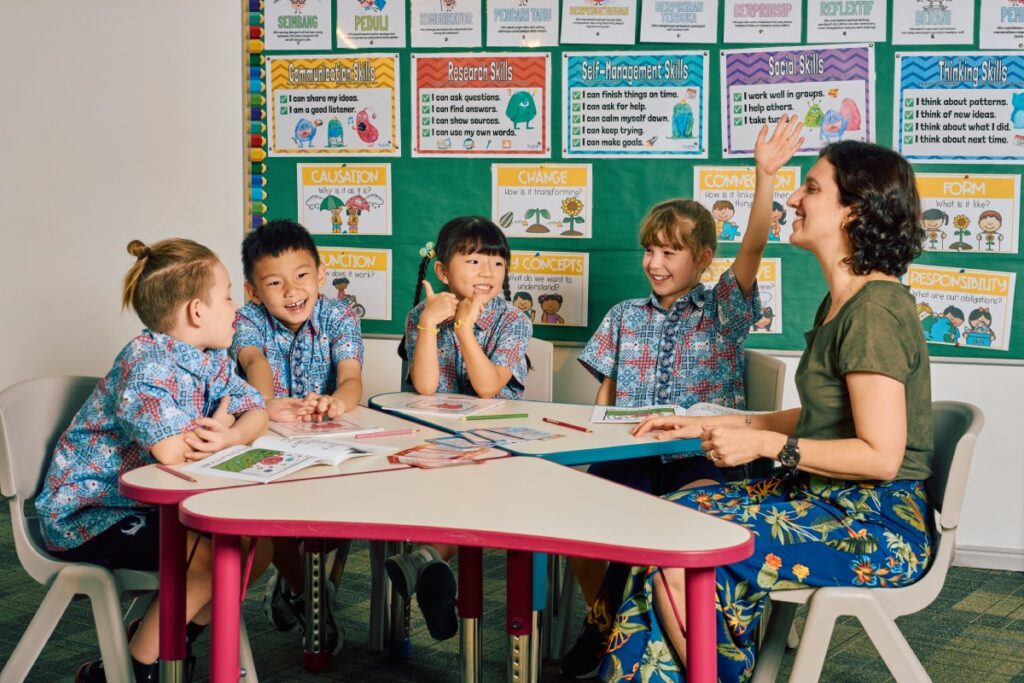
Absolutely, so we have about 280 students in total, which is roughly one class per grade – maybe more in Primary Years. What’s fabulous about this is the friendships that develop between the year groups, how they interact with each other, not just their peer groups, but throughout the building.
You’ll see when you enter the building that there’s a flag representing each of the nationalities at the school. It’s not about the colour of someone’s passport, but rather it’s about the culture that they bring and how this is shared and exchanged between the students. It’s in our name, intercultural, and we bring that together into one big, supportive community.
At NJIS, you offer the full International Baccalaureate (IB) Continuum. What does this mean exactly?
It means that we run three IB programmes consecutively. This begins with the PYP, or Primary Years Programme, which is about building foundations through play-based learning and developing that inquiry mindset. This transitions to the MYP, or Middle Years Programme, where we take that foundation and start applying learning to real life situations, develop more analytical thinking, problem solving and communication. Then in the final two years we have the Diploma Programme, or DP, which is where we see the real weight of the academic rigour. It’s a robust pre-university preparation and gets them ready for those first independent years and beyond.
You mentioned transitions, how are these better managed by offering the full IB Continuum?
Not shifting the types of curriculum helps to ease those transitions between key stages. Children thrive on having consistency, and by having that same style and language of learning, they can excel. By having these cohesive programs, they all bridge so well between one another. It’s normally in the transitions where kids can fall through the cracks, whether that’s changing schools or programmes. By offering that consistency, we provide that sense of stability and security for the students, allowing them to enjoy their school days more fully.
What about the IB system and culture is so beneficial to students?
What I feel is the most valuable aspect of the IB is its inquiry mentality. When I went to school – and still in many schools today – there’s a focus on memorisation. The inquiry approach teaches students to question, and if they don’t have the answers, it becomes about how they can find the answers. This is a big educational shift.
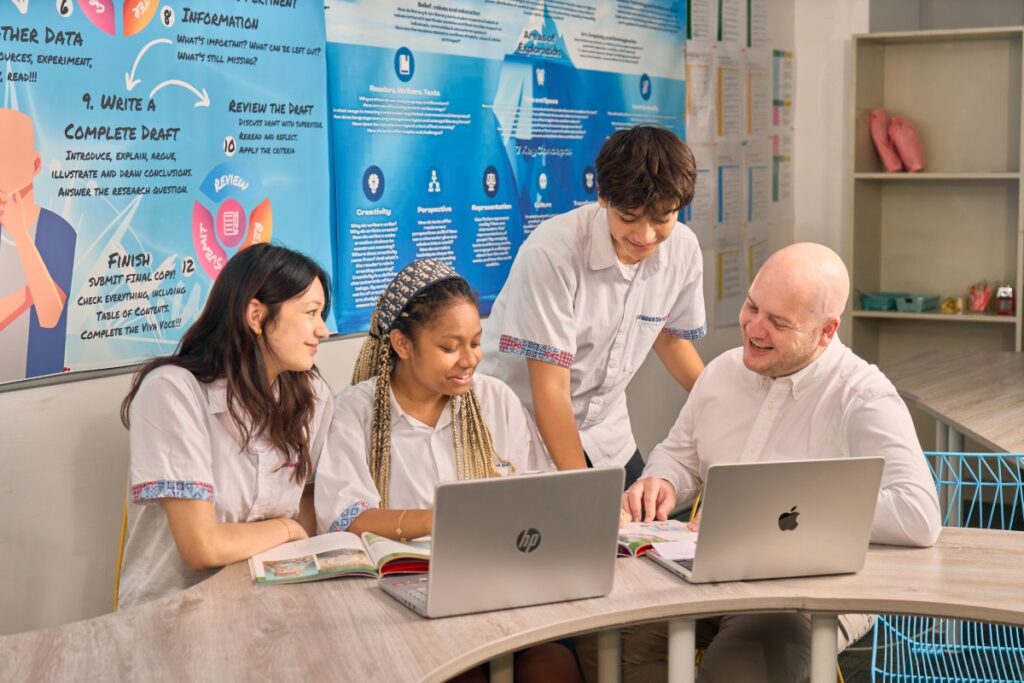
When we have an open house here, I always ask families what they want from a school, and never have I had a parent say my son needs to be the next mathematical genius, or my daughter needs to be the next Picasso. They always want their children to be happy, have friends and enjoy learning. With the International Baccalaureate, there’s a wealth of non-academic programs that are really beneficial to the student. There’s CAS – Community, Action, Service – at the higher levels, but elements of these are visible throughout the continuum. For example, at PYP we have what are called ‘Units of Inquiry’, which are themes of study which after learning encourage an action. This might be learning about fossil fuels and the effect on the planet, and they decide, independently, not to leave their AC in the room all day. So they learn about the global subject, then find ways to apply that locally, practically. You’ll see that this helps them become mentally mature, and plant seeds of ‘action’ early.
We want our students to be internationally minded, and to grow up with a global perspective. Of course, we ensure there is academic rigour, but then we also help to develop each child’s disposition, ensuring that they grow up with positive characters.
How do you think NJIS offers a distinct educational experience here in Jakarta?
I think, you know, bigger is not always better. When I think about the end advantage, I believe we have a small school superpower. The teachers, the homeroom teachers, the advisors know the unique needs of each individual child and how to accommodate that child better.
Just as important is that here, every student gets a turn. Everyone can get involved in a leadership role, be it presenting at assembly, running a club, playing on a sports team. Those opportunities to be involved are really important for growth. Imagine how it feels for a parent sitting in the auditorium and seeing their son or daughter, who is in grade two, leading a school assembly – confidently standing up on stage in front of three hundred people! That’s where I think NJIS offers a different experience, outside of our curriculum, and those opportunities are supported wholeheartedly by the entire school community.
North Jakarta Intercultural School
Jl. Boulevard Bukit Gading Raya, Kelapa Gading
+62811 927 8887 (WA) | admissionsteam@njis.org
njis.org