


Betawi culture has long been shaped by diverse influences dating back to the colonial era. This multicultural heritage is clearly reflected in its traditional wedding attire, which blends European, Arabic, and Chinese elements into a distinctive and vibrant visual identity.
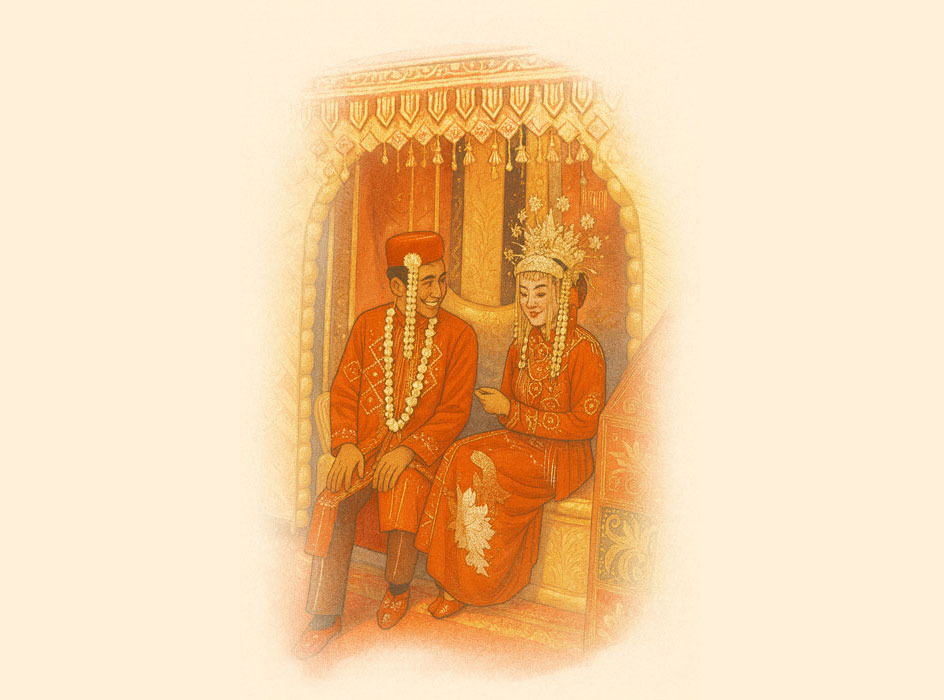
A traditional Betawi wedding is an extended celebration filled with joy, music, and lively customs. After the marriage ceremony, the bride and groom welcome guests in their unique ceremonial attire, known as Tata Rias Besar or Tata Rias Gede.
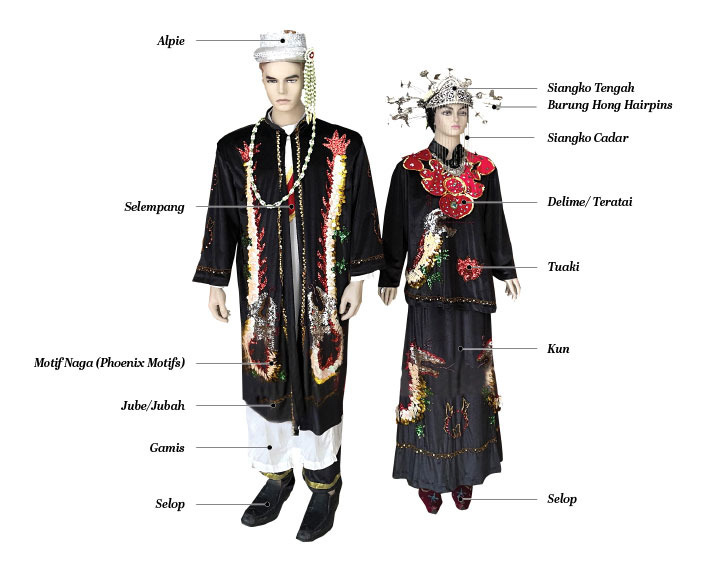
The groom’s outfit, called Dandanan Care Haji, draws strong inspiration from Middle Eastern clothing. The first element is a long, brightly coloured robe or jube (jubah). Designed with a loose, flowing silhouette, yet its gold-embroidered embellishments reveal Chinese cultural influences, often incorporating motifs such as phoenixes, flowers, geometric patterns, and even mosque domes. In Chinese symbolism, the phoenix represents good fortune.
Beneath the robe, the groom wears an ankle-length inner garment or gamis, which functions as both an underdress and trousers. The head covering, known as an alpie, is a distinctive turban-like hat about 15–20 cm tall. It is typically wrapped in white or gold fabric and adorned with red roses and strands of jasmine cascading from one side. It symbolises the groom’s devotion to religious teaching and his commitment to marriage.
Another attribute is a selempang (sash) approximately 2-metre long and 25 cm wide, worn diagonally across the body from the left shoulder to the right hip. Worn beneath the robe, this sash signifies regality, while the left-to-right direction reflects the hoped, for course of life, toward goodness, prosperity, and success.
The groom also carries five to seven sirih dare (betel leaves), folded upside down as symbols of the marriage bond, loyalty, and obedience. Inside the leaves are tucked red roses, representing love, and uang sembe, a traditional monetary offering symbolising respect and sincere intention toward the bride’s family.
The bride’s ensemble, known as Dandanan Care None Pengantin Cine, highlights powerful Chinese influences. These are evident in bright colours, often red, and the ornate headpieces and accessories that give the bride a regal, elegant presence.
The bride wears a long-sleeved blouse with a high Shanghai-style collar called a tuaki made from satin or velvet and decorated with gold beads for a radiant, shimmering effect. The colours typically match the groom’s attire.
Chinese cultural influence appears prominently in the decorative motifs of dragons and phoenixes, two mythological creatures symbolising balance: the dragon for strength and authority, the phoenix for grace and beauty. The skirt, called a kun, falls to ankle length.
The chest covering, known as delime or teratai (lotus), consists of eight symmetrical layers of velvet decorated with gold-coloured metal plates shaped like tanjung flowers or star motifs. This layered ornament symbolises marital fertility.
The bride’s hair is styled in a sanggul cepol (chignon) formed into three tight coils. This bun is richly adorned with various shapes and amounts of hairpins including four burung hong (hong birds) symbolising the four companions of the Prophet Muhammad, 16 kembang goyang (shaking flowers) and two kembang kelapa (coconut flowers) symbolising the 20 qualities of Allah that His servants must know, and 10 paku (nails) hairpins which are repellants against evil.
The headdress is called siangko which consists of three types with different sizes; the siangko cadar (crown with a veil) is made of gold or silver with beaded decorations which are worn by attaching it to the forehead and tying it to the back of the head, the siangko tengah or siangko tenge (middle crown) which is worn above the crown of the head, and the siangko buntut (crown of tails) is used as a cover for the knot on the siangko cadar.
Another distinctive accessory is the lam pin, shaped like the Arabic letter lam. Lam pins are typically decorated with gems or diamonds along their length and further adorned with flowers.
For footwear, both groom and bride wear selop perahu kolek or selop kasut (loafer-style shoes) like Dutch clogs.