


It is hard to miss Metropole XXI when walking around Cikini, Central Jakarta. Located near the junction of
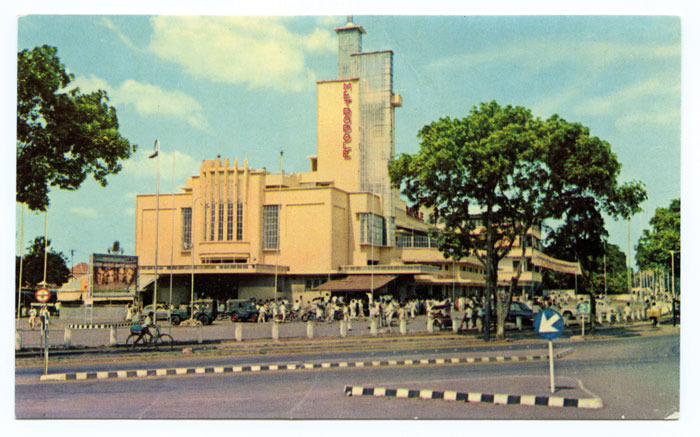
Jl. Diponegoro, Jl. Pegangsaan Timur, and Jl. Proklamasi, the multipurpose building stands out with its stark-white exterior and looming tower. Its name, arranged vertically in gold lettering, immediately draws the eye.
Designed by architect Liauw Goan Seng, Metropole adheres to the late Art Deco tradition. Narrow, stacked windows pull the gaze upward, while the facade keeps decoration minimal and structural, favouring stepped forms, clean edges, and flat surfaces. Rooted in the broader evolution of Art Nouveau, the design emphasises geometry and balance, making Metropole one of the few large-scale Art Deco buildings that remains clearly recognisable in Jakarta today.
To understand why the building holds an important place in the capital’s history, it helps to return to the moment of its opening. In the early 1950s, going to the cinema was one of Jakartans’ most popular pastimes. Television had not yet arrived, and cinemas shaped how people spent their evenings and weekends. They quickly multiplied across the city, but Metropole stood out immediately when it opened in 1951. The first film shown there was Annie Get Your Gun, starring Betty Hutton and directed by George Sidney.
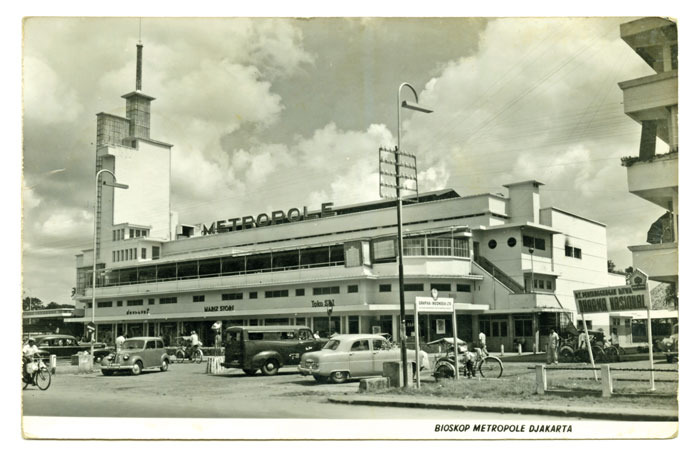
JAKARTA: Portraits of a Capital 1950-1980 by Scott Merrillees
The era also brought renewed energy to Indonesian filmmaking. Local directors and producers were prolific, even though access to major screening venues remained limited. Most first-class cinemas preferred imported films, viewing them as safer commercial choices. Metropole disrupted this pattern in 1954 by screening Krisis (Crisis) directed by Usmar Ismail, after it had been rejected by another prominent cinema. The decision carried risk, yet the result was decisive. The film played for four weeks and drew large audiences, offering a rare demonstration that Indonesian productions could succeed on the same screens as international releases.
That gave Metropole a reputation that went beyond architecture. It became a venue where confidence in local cinema could be tested in public, in front of mixed audiences that included students, civil servants, and cultural figures. Over time, the building hosted films shown during the first Indonesian Film Festival in 1955 and later supported the 16th Asia Pacific Film Festival in 1970.
Names proved less stable than the building. In 1960, the cinema was renamed Megaria following a directive from President Sukarno, who considered the word “Metropole” too foreign, and as part of a broader effort to assert national identity in public space. Early in the Suharto era, the original name returned, before disappearing again later in the New Order period to make way for Megaria Theatre.
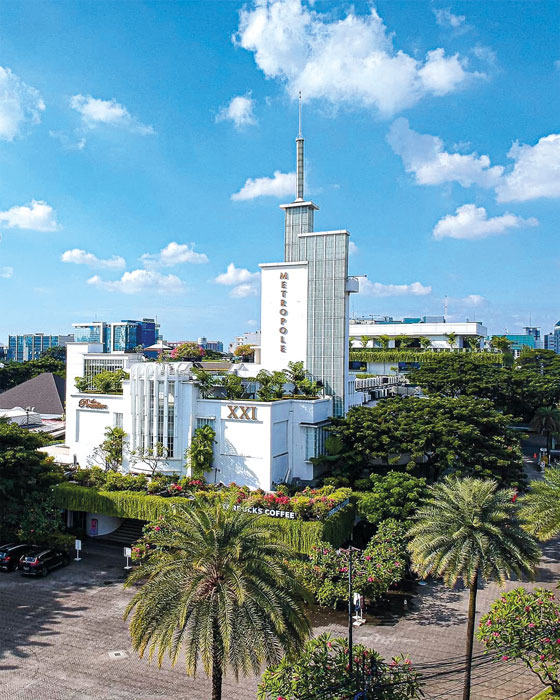
Photo credit: © @jakarta_tourism
In 1989, when the building was leased to the 21 Cineplex chain, it became Metropole 21, then Megaria 21, and finally Metropole XXI, which it remains today.
The building is recognised as a Class A Cultural Heritage site under the Jakarta Gubernatorial Decree No. 475/1993, and continues to screen films in a format adapted to contemporary viewing habits. Its original large, single auditorium has been divided into smaller theatres, and the surrounding complex now includes cafés and retail spaces. The exterior remains largely intact, keeping the building tied to its earlier life.
Sources:
Haris Jauhari (ed.). Layar Perak: 90 Tahun Bioskop di Indonesia. Jakarta: Gramedia Pustaka Utama, 1992.
Merrillees, Scott. Jakarta: Portraits of a Capital 1950–1980. Singapore: Equinox Publishing, 2015.
Sri Pudyastuti R., Moebanoe Moera, Dwi S. Irawanto, and Sarluhut Napitupulu. “Zaman Keemasan Kelompok 21.” Tempo, 29 June 1991.
Tjasmadi, H.M. Johan. 100 Tahun Bioskop di Indonesia (1900–2000). Jakarta: Megindo Tunggal Sejahtera, 2008.