


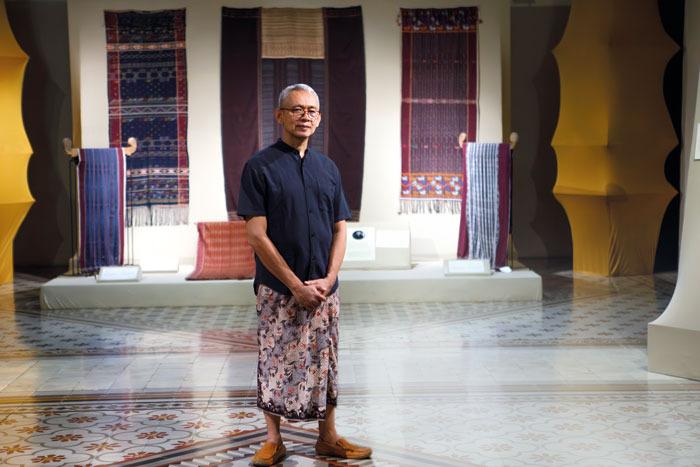
Sometimes, all it takes is a single encounter to change the course of a life. For Benny Gratha, it was a museum visit that first drew him into the world of Indonesia’s traditional fabrics. Curiosity became passion, and passion became a lifelong calling. Today, as a wastra curator, Benny safeguards not only remarkable fabrics, but the stories, traditions and identities woven into every thread, ensuring they continue to speak to generations yet to come.
Benny Gratha, or simply Benny, sat quietly in his tidy room, his hand gliding across the computer mouse as he searched the database for a serial number. Moments later, with a stack of documents tucked under his arm, he strode purposefully towards another room. Behind its doors lay rows of towering metal shelves lined with rolls of cloth, each carefully wrapped in protective gauze. To the untrained eye, they might have appeared to be little more than bundles of fabric. But to Benny, every roll held a story waiting to be discovered and preserved.
After locating the corresponding serial number, Benny carefully retrieved one of the long rolls. Before taking it to his workroom, he checked the temperature and humidity of the storage area, ensuring that the conditions were suitable for handling the fabric. He then closed the door behind him.
At a large table, he carefully unrolled the fabric and spread it out. As he lifted away the gauze and white paper protecting it, gold threads emerged, framing a slightly faded brick-red hue.
“This is a Limar songket from Palembang, South Sumatra. It is more than 100 years old,, estimated to have been made in the early 20th cebtury.” he told the NOW! Jakarta team, as he proudly showed us this historic textile.
Benny explained that the age of a fabric can be determined through carbon dating, in which a small sample is analysed using an Accelerator Mass Spectrometer to establish its approximate age.
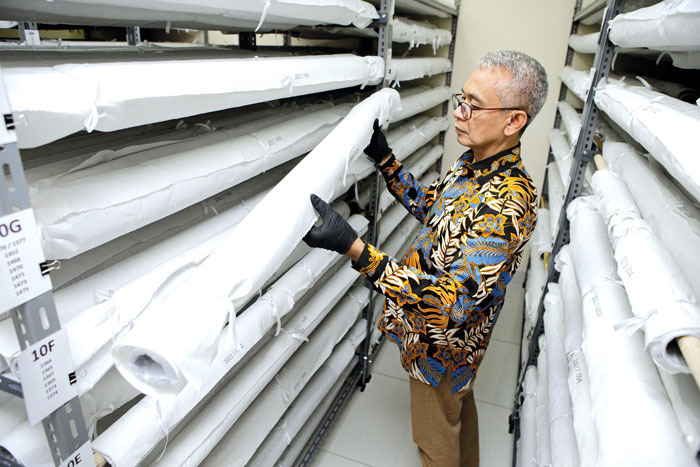
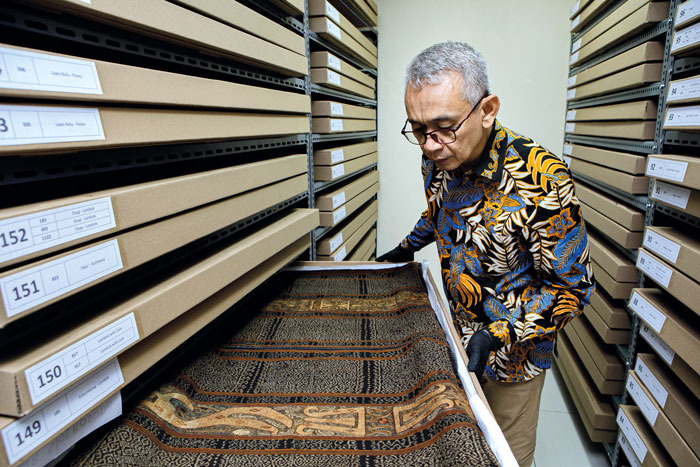
(Left) Benny Gratha selects one of the long rolls of traditional fabric for closer examination; (Right) With a keen eye for detail, Benny Gratha carefully inspects each wastra, ensuring every piece is well preserved and remains in good condition, an essential part of his work as a curator. Photos by Des Syafrizal.
He then reached for a magnifying tool and began examining different sections of the fabric. Carefully studying the condition of its fibres, he recorded his observations in a notebook. Once he had finished, he went to another room and returned carrying three more pieces of cloth, believed to have originated from Timor and other parts of eastern Indonesia. Their vivid colours immediately stood out, a distinctive characteristic of fabric from the region.
One by one, Benny examined each piece with the same cautious care he had given to the Limar songket, studying its intricate details, documenting his findings and assessing its condition to ensure that it could be preserved for future generations.
“Here, the fabrics are stored with great care to prevent damage. That is one of my responsibilities,” Benny explained, gesturing towards the different rooms at the Sarirasa Origin office, where he now works as a custodian of Indonesia’s fabric heritage.
“Earlier, I showed you a room filled with rolls. Those are fabrics that are still in good condition, stored that way to prevent them from becoming creased. Then there are rooms filled with boxes containing padding, specifically for fragile fabrics that should not be moved around too much. These precious fabrics need to ‘rest’ properly. I also avoid touching them with bare hands to minimise contamination. That is the level of care involved,” he continued.
Benny says that becoming a wastra curator was something he had never imagined. At the time, his knowledge of Indonesia’s traditional fabrics was extremely limited; in fact, he knew very little about the subject. He was not even particularly fond of wearing batik. Despite its status as a national icon, he found its dense and intricate patterns somewhat overwhelming.
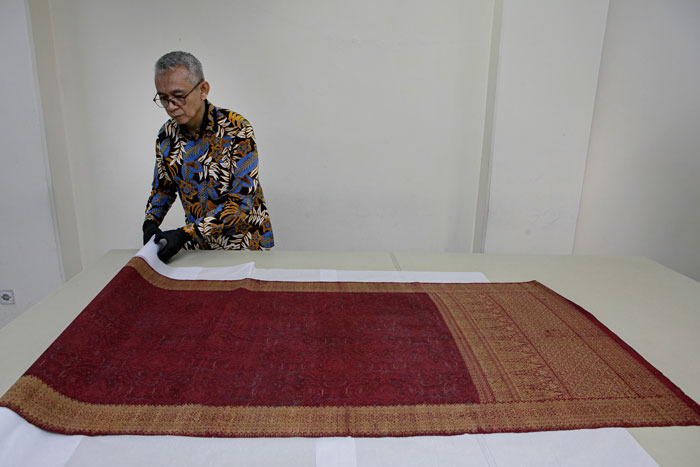
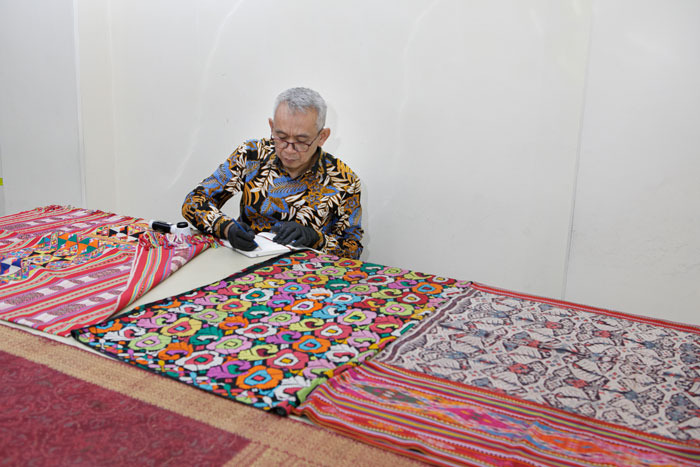
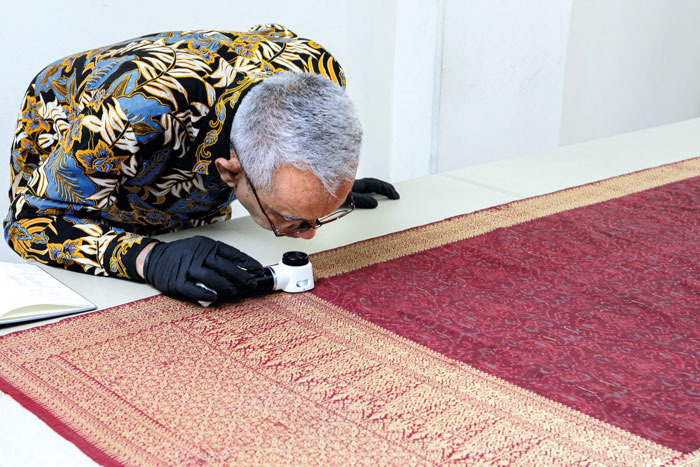
(Above) Benny Gratha unrolls an old Limar songket, inspecting its delicate threads and intricate weave to ensure that the historic wastra remains in good condition.; (Below-Left) Benny Gratha records every detail he observes about the condition of each piece of wastra, documenting his findings in the collection’s database for future reference and preservation; (Below-Right) Benny Gratha examines the intricate threads of Limar songket, carefully studying its craftsmanship and details.Photos by Des Syafrizal.
With a degree in Marine Science and Technology from IPB University. Benny initially pursued a career far removed from fabrics and textiles, working in Indonesia’s national IT industry. His path took an unexpected turn in 2005, when he resigned after realising that office life was not the right fit for him. He became a blogger and joined a community that regularly held activities at the Textile Museum.
What began as casual gatherings to exchange interesting stories and photographs gradually led to a deeper connection with the museum. His curiosity grew, and he began exploring the art of batik-making.
As his visits became more frequent, Benny gradually became a familiar face among the museum staff and was eventually appointed as an assistant curator. His diligence quickly became apparent, particularly in preparing exhibitions and guiding visitors. The role brought him closer to the collections and gave him the opportunity to learn more deeply about Indonesia’s wastra.
It was at the museum that his curiosity about wastra truly blossomed into passion. He immersed himself in its history, philosophy and techniques, constantly looking for opportunities to research and expand his knowledge. He particularly enjoyed sharing what he discovered with visitors.
“I truly enjoy explaining wastra to visitors. It is deeply satisfying to see them respond with enthusiasm to the information I share, especially when they ask questions that go beyond what I have presented. It feels like a job well done,” Benny recalls of his time at the museum.
Perhaps the most rewarding chapter of Benny’s journey has been travelling across Indonesia, from well-known regions to remote corners, to witness first-hand the intricate processes behind traditional weaving and fabric-making.
“Seeing the craftsmanship up close and learning about the traditions, techniques and stories woven into each piece deepened my appreciation of Indonesian wastra and gave me a profound understanding of the cultural heritage they represent. More importantly, this knowledge is crucial for a wastra curator when determining an exhibition theme. Understanding the philosophy, history and culture behind each fabric makes it easier to select the right pieces for display and, ultimately, to craft a meaningful narrative around them,” Benny said.
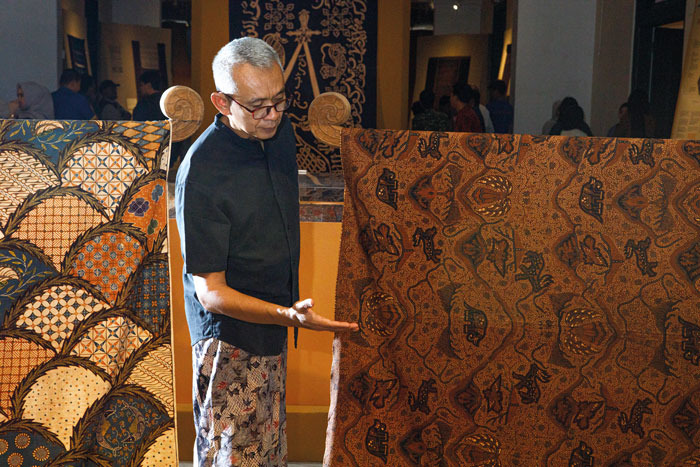
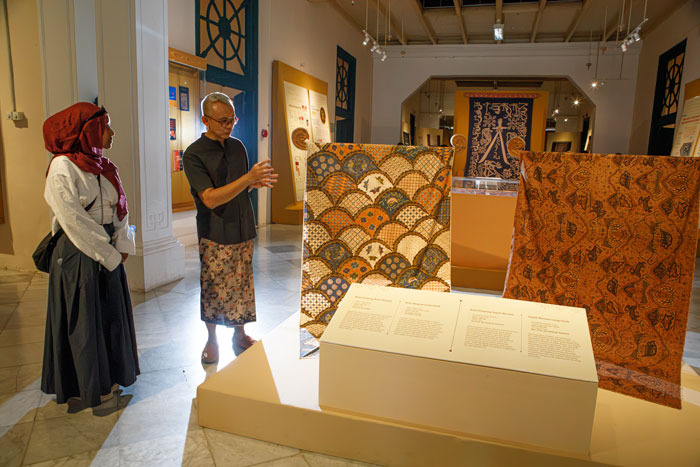
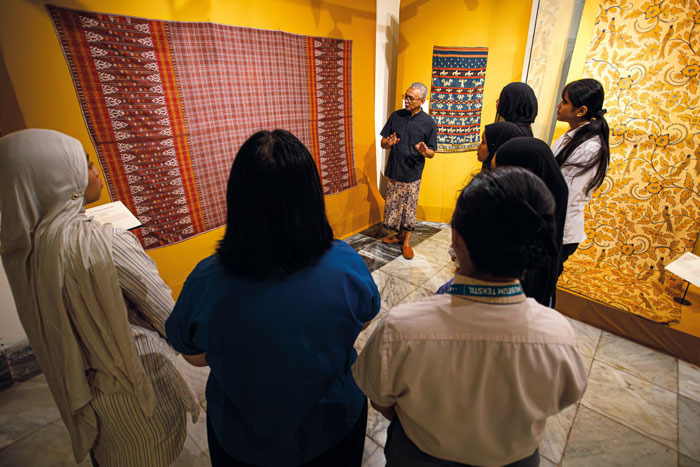
While working as a guide at the Textile Museum, Benny Gratha took great pleasure in sharing the richness of the Nusantara’s wastra heritage with visitors. What made the experience especially rewarding was seeing their curiosity grow as they began to understand the stories and traditions behind each piece. Photos by Des Syafrizal.
Benny has witnessed the extraordinary richness of Indonesian wastra, from its materials and motifs to its diverse techniques. He deeply admires the artisans of Pandai Sikek, West Sumatra, known for their rich songket traditions, as well as the makers of Balinese gringsing, renowned for their intricate weaving techniques and natural dyes. He is equally fascinated by the woven traditions of Eastern Indonesia, including the buna technique of Timor Island, East Nusa Tenggara, in which additional weft threads are manually inserted into the warp to create a raised texture visible on both sides of the fabric. The diversity also extends to the many forms of ikat, including ikat ganda (double ikat), ikat lungsi and ikat pakan.
After serving as an assistant curator at the Textile Museum, Benny decided to leave in 2015 and pursue a career as an independent wastra curator. Since then, he has frequently been invited to share his knowledge and stories about Indonesia’s traditional fabrics at exhibitions, seminars and workshops. Interestingly, his expertise has also made him a trusted name among wastra collectors, socialites and even government officials, who regularly turn to him for advice when buying, selling or researching treasured pieces.
By 2021, Benny’s journey had taken another meaningful turn. He began working closely with Sarirasa Group founder Benny Hadisurjo to develop Sarirasa Origin, a space for cultural preservation and development established by the group as a testament to its commitment to safeguarding Indonesia’s rich cultural heritage.
At Sarirasa Origin, the archipelago’s cultural legacy is collected, preserved, documented and studied. Yet the work goes beyond safeguarding artefacts. Through its collections and programmes, the company seeks to bridge past and present, ensuring Indonesia’s cultural heritage is not merely preserved, but understood, appreciated and kept alive for future generations.
Here, Benny is entrusted with safeguarding more than 2,500 pieces of Indonesian wastra. Each is more than a work of craftsmanship; it is a fragment of Indonesia’s cultural memory, carrying stories, traditions and knowledge that deserve to be preserved and passed on.
When asked what concerns him most as a textile curator, Benny expresses deep concern about the many regions across Indonesia where the weaving and fabric-making practices in communities have gradually fallen out of use. He points to Pasemah in South Sumatra where the same case happened meanwhile in Lampung, the weaving tradition has shifted towards tapis embroidery. In Sangir Talaud, North Sulawesi, the once-thriving tradition of making koffo cloth from banana fibres has also disappeared. The practice was lost after banana trees were cleared for other crops during the era of forced cultivation, and subsequent efforts to revive it have yet to fully succeed.
Benny aspires to document the wastra of every region in Eastern Indonesia, where many textile traditions remain largely undocumented and little research or literature exists. His determination stems not only from his calling as a wastra curator, but also from a deep sense of responsibility as an Indonesian who loves and values his cultural heritage.
The photos taken at:
Sarirasa Origin Office (Sarirasa Group),
Jl. K.S. Tubun No. 23, Central Jakarta
Textile Museum, Jl. K.S. Tubun No. 2-4,
Palmerah, West Jakarta.