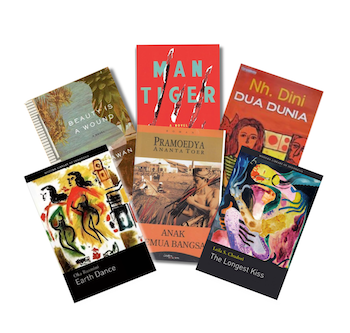



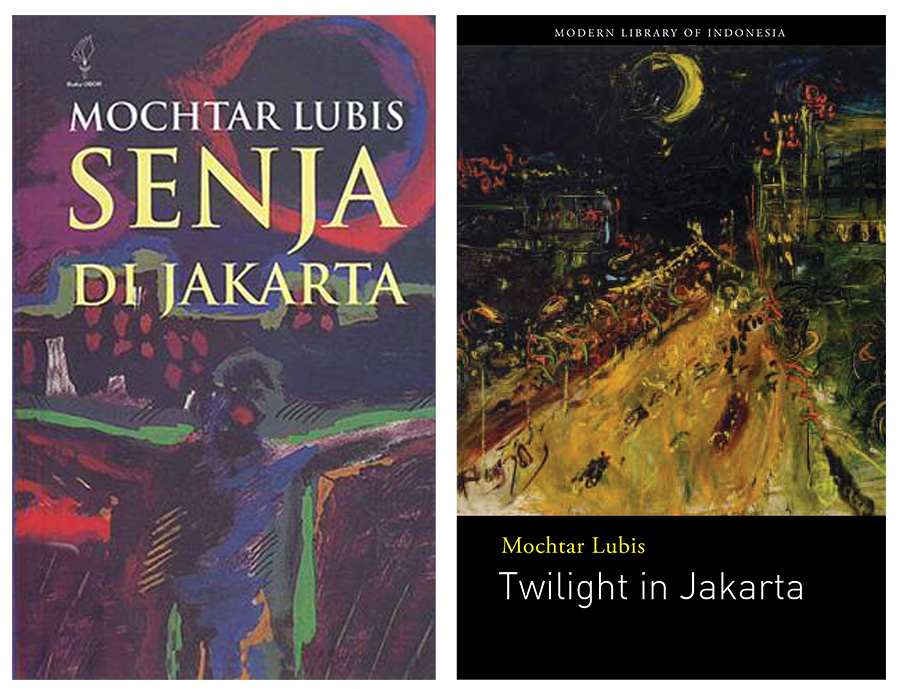
Guest writer, Steven Lumban Tobing reviews the English translated ‘Twlight in Jakarta‘ (Senja di Jakarta) by Mochtar Lubis as part of our series ‘Sastra Book Club: Indonesian Literature Review
Mochtar Lubis’s Twilight in Jakarta is not simply a novel about a city. It is a novel about what Jakarta does to people, and what people become when a society’s ideals begin to collide with the realities of power. The novel was first published in English in 1963, by the publishers Hutchinson & Co. based out of London – the first Indonesian novel ever to appear in an English translation. The novel did not reach Indonesian readers, under the title Senja di Jakarta, until a Malaysian edition was published in 1964, and only reached Indonesia itself in 1970.
That publication history is itself a kind of preview of the novel’s argument. The manuscript was written while Lubis was under house arrest in the 1950s, smuggled out of the country in 1960 by Frode Jacobson, a Danish resistance figure, and translated into English by Claire Holt, with Lubis himself editing her draft during a stopover in Paris in 1961. It reached readers in London two years before it could be published at home. Lubis later learned that the organisation which had sponsored the translation had been covertly funded by the CIA, a fact that would not have surprised any character in this novel, in which noble language and hidden interests are never far apart. In Twilight in Jakarta, the gap between the promises of independence and the realities are brought to the fore.
In a nutshell, the novel tells the story of post-independence Jakarta, mid-1950s under first President Sukarno’s leadership. It follows the parallel lives of several characters from across the city’s social strata – from Suryono (a young, Western-educated elite) to Saimun and Itam (garbage collectors and becak drivers), to newspaper editors and academics. It depicts the views, lives and nature of the city’s various echelons.
Reading this novel in English also means reading a specific act of translation, and it is worth pausing on. The Lontar Foundation’s 2014 edition revises Holt’s original 1963 text, and the prose reads with a fluency that doesn’t betray its age. What the revision keeps, tellingly, is the original’s deliberate decision not to translate everything: becak, kretek, kain, warung, delman, and magrib remain in Indonesian, while the world of the elite Suryono arrives already fluent in English and embracing of the Western: Lucky Strikes, Cary Grant, the tune from “High Noon”, Sartre quoted in the original French. The novel’s class divide is written into its very vocabulary.
The title itself perfectly captures the two distinct reals. Twilight is neither day or night; it is the unstable space between them. Lubis’s Jakarta exists in much the same condition. Colonial rule has ended, yet the habits and inequalities it left behind have not disappeared. Indonesia is politically independent, but independence has not translated equally into economic or social freedom. The country has acquired sovereignty, while many of its citizens remain trapped by poverty, patronage and unequal access to power.
This tension between independence and inequality is perhaps the novel’s most important concern. Lubis does not question the value of independence itself. Instead, he asks what independence means when the people who inherit political power begin reproducing the very inequalities that independence was supposed to overcome. The foreign ruler may have disappeared, but exploitation can survive under new names and new faces.
Yet Twilight in Jakarta never allows politics to remain an abstraction. This is one of Lubis’s greatest strengths. Decisions made in political offices eventually reach markets, homes and streets. Inflation, shortages and corruption determine what people eat, whom they trust, what they fear and what they are willing to sacrifice. Politics becomes intimate. The condition of the nation is reflected not through speeches, but through ordinary lives slowly being altered by forces beyond their control.
The novel’s social landscape is particularly effective because Jakarta itself feels like one of its characters. The city is crowded, restless and constantly transforming. People arrive with ambitions, hopes and fears, only to discover that the city rewards some while consuming others. The distance between wealth and poverty is not merely economic; it becomes a psychological and moral distance. Those who possess power can afford to treat political problems as opportunities, while those without it experience the same problems as threats to their survival.
There is something strikingly modern about Lubis’s Jakarta. His characters inhabit a city filled with competing identities: traditional and modern, idealistic and cynical, Indonesian and cosmopolitan. They are attempting to define themselves in a society whose old order has been disrupted, but whose new order remains uncertain. Everyone seems to be moving, yet few know where they are going.
This uncertainty is also reflected in the novel’s treatment of the Indonesian middle and upper classes. Lubis is interested in the gap between appearance and reality: respectable people making questionable decisions, patriotic language masking personal interests, and public virtue existing alongside private compromise. The result is a world in which social respectability cannot necessarily be trusted as evidence of moral character.
Lubis’s background as a journalist is evident in his prose. He observes rather than romanticises, exposing the mechanisms beneath appearances. This is most visible in the novel’s “City Beat” interludes, brief interruptions that read closer to wire reportage than to fiction, flatter in tone, faster in pace, stripped of the interiority given to Suryono or Sugeng. In Claire Holt’s translation, as revised by John H. McGlynn, that register is kept rather than smoothed into something more novelistic, and Lubis’ desired literary effect survives in the English versions: the reader is reminded, again and again, that the private dramas of the main cast are only one layer of a much larger, indifferent city. At times, this journalistic quality can make the novel feel more interested in society than in the intimate psychology of individual characters. Some characters function almost as embodiments of particular social forces, and certain passages carry the weight of reportage more than conventional literary fiction. But this distance is also part of the novel’s power. Lubis is not interested in giving Jakarta a flattering portrait. He wants to show how private lives become inseparable from public failures.
There is, however, a certain bleakness to this vision. Lubis rarely allows his characters the comfort of believing that individual virtue is enough to overcome a broken system. Good intentions can be overwhelmed by circumstances, while ambition can be rewarded precisely because it is willing to abandon principle. This does not make the novel nihilistic. Rather, it makes its moral questions more difficult. Lubis asks us to consider not only whether people are good or bad, but what kind of society makes certain choices easier than others.
Reading Twilight in Jakarta more than six decades after its publication produces an uncomfortable sense of recognition. Jakarta belongs to another historical moment, but the points raised remain remarkably familiar. What happens when political influence becomes a form of currency? What does independence mean when economic inequality persists? How easily can the language of public good become a justification for private ambition?
These questions give the novel a relevance beyond its historical setting. Contemporary readers may recognise the broader patterns even when the specific political circumstances have changed. The relationship between wealth and political influence, the vulnerability of the poor, patronage, corruption and the distance between nationalist rhetoric and everyday reality remain recurring problems in societies undergoing rapid political and economic transformation.
This is also where the novel becomes more than a historical document. Twilight in Jakarta reminds us that history is not made only by presidents, politicians or institutions. It is experienced by individuals. A policy becomes a meal that a family can no longer afford. Economic instability becomes a marriage under pressure. Political corruption becomes a decision about whom to trust. The national crisis eventually enters the private sphere.
Ultimately, Twilight in Jakarta is a novel about a country learning how to live with its freedom. Twilight is therefore more than a time of day: it is the condition of a nation standing between what it has escaped and what it has yet to become. Lubis offers no easy dawn. Instead, he leaves us in a city illuminated by uncertainty, where the promise of a new Indonesia is continually threatened by the darkness within it.
Perhaps that is precisely why the novel still matters. Lubis does not ask us merely to remember Indonesia’s past. He asks us to recognise how history enters ordinary lives, how political ideals acquire personal consequences, and how easily the dream of independence can be compromised when power becomes something to be possessed rather than shared.
Twilight in Jakarta ultimately leaves its reader with an uncomfortable question: after winning the freedom to determine its own future, what kind of country will Indonesia choose to become? Lubis does not answer. He simply turns the city towards us at dusk and asks us to look.