


When entering Olafur Eliasson: Your curious journey at Museum MACAN, your vision tilts, the colour thickens, and the world outside is muted. They say that our body adjusts before our mind does, an adjustment period one can really feel when immersed in the artist’s installations.
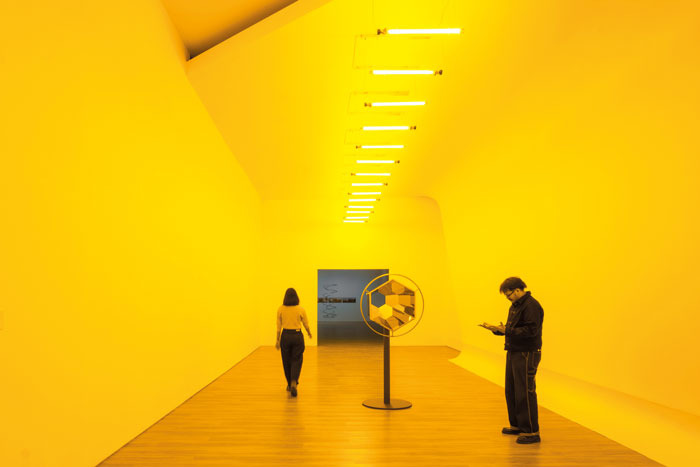
There are rooms shaped by mist, reflections, shadows, and slow-moving time. Rainbows that appear only at certain angles, multiplied silhouettes that refuse to stay aligned. Then visitors are led into a corridor saturated in yellow that compresses perception before opening to a space with glacial images stretching across decades. Drawn from more than thirty years of practice, the exhibition unfolds as a sequence of environments to be entered, where looking gives way to sensing and our own movements become part of the art itself.
In this exhibition, Eliasson gathers works that ask how perception is physically shaped. Light, water, fog, reflection, and magnetism are not just metaphors but active agents. These installations refuse the idea of art as something finished on arrival. Each work waits for the beholder. It needs your movement, your hesitation, your willingness to stand still or step closer. Only then does it begin to function. Like Schrödinger’s Cat, it needs the observer.
The galleries are arranged less as a chronological work and more as a sequence of encounters. In Beauty (1993), a thin curtain of mist catches a beam of light, producing a fragile rainbow that appears and disappears depending on where you stand. It is destabilising: you adjust your body, and the work adjusts with you. At first glance, the effect makes for a camera-worthy spectacle, (no doubt you’ll get a cool Instagram picture out of it), but the experience it offers is one of attentiveness, a reminder that seeing is conditional and that perception can shift from moment to moment.
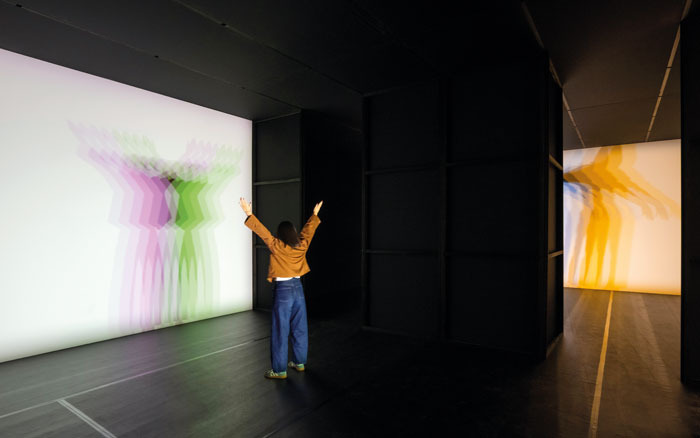

Elsewhere, Multiple shadow house (2010) fractures visitors into overlapping silhouettes of colour. Green, magenta, cyan shadows detach from the body, lag behind it, refuse alignment. Children test the edges of their multiplied selves; adults do the same, more cautiously. Identity here is provisional, spatial, contingent on light sources you cannot see but feel.
Several works stretch time outward. The glacier melt series documents the slow disintegration of ice over decades, images lined up with forensic restraint. There is no overt drama. The accumulation does the work. Standing before them, the scale of loss becomes bodily rather than statistical. You sense duration pressing against the present.
At the centre of the exhibition, Multiverses and futures (2017) offers kaleidoscopic instruments that fracture the surrounding space into shifting geometries. The museum repeats itself endlessly, reassembled into unfamiliar configurations. Orientation becomes optional. Perspective slips. The work unsettles, insisting that uncertainty can be productive and immersive.

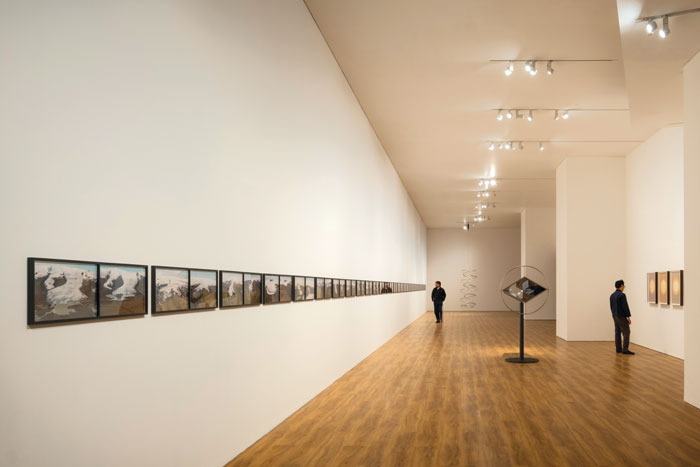
Across the exhibition, there’s a demand on the body that repeats itself in different registers, sometimes quietly, sometimes insistently, asking visitors to slow their pace, to recalibrate their attention, and to notice how quickly habit takes over perception. The museum begins to feel like a space that regulates speed. It is here, in this insistence on presence over immediacy, that the exhibition’s underlying concerns begin to surface.
When asked whether slowing down inside the exhibition might help visitors regain a sense of agency in a city as relentlessly paced as Jakarta, Eliasson speaks less about solutions than conditions. “If there is no embodied presence and no somatic knowledge, it doesn’t really register as engagement,” he says, describing a widespread numbness that stretches across generations. Speed, screens, and constant mediation, he suggests, have made isolation feel normal.
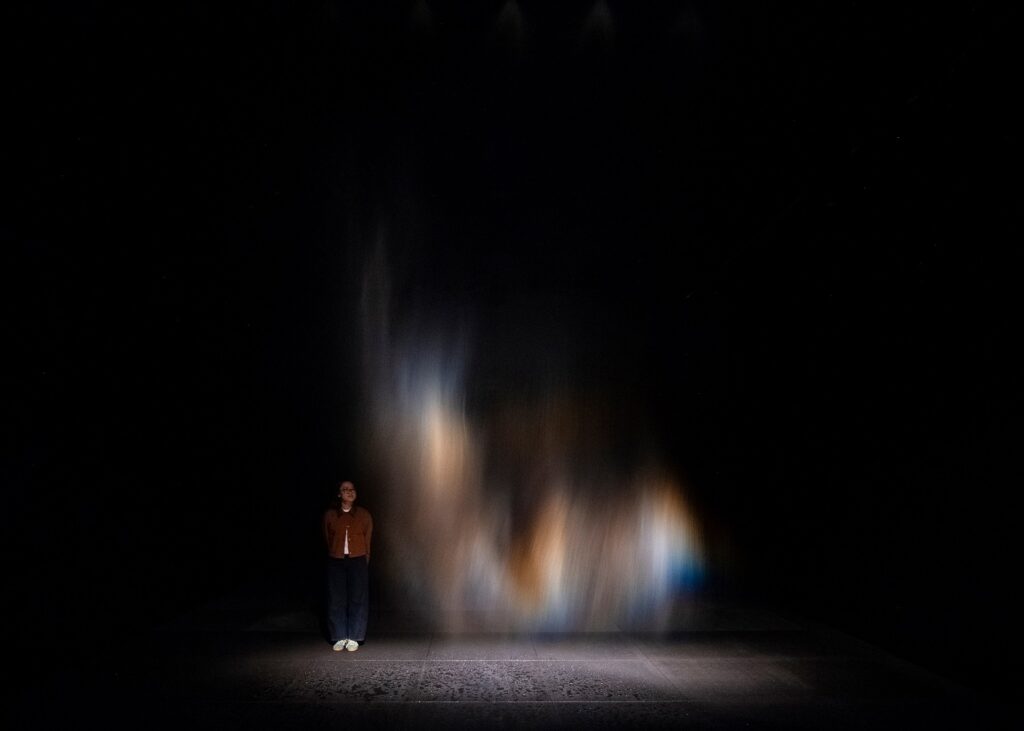
Slowing down, for him, is a resistance: “When I slow down, I actually take in more. I see more. I become more sensitive.” The artworks, he notes, are designed to create spaces that can be inhabited, places where vulnerability is possible, defensiveness softens, and where, perhaps, people begin to question not only what they see, but why they have placed themselves at the centre of it all.
Here, you notice your own breathing. You notice others moving through the space. You notice how easily the agency returns when you are asked to participate rather than consume. And by the time you leave, the city does not rush back immediately. The eye lingers and the body remembers how it felt to move more deliberately, to be implicated in what it sees.
Your curious journey does not promise answers. It offers conditions for attention, vulnerability, and connection, and leaves it to you to decide how long to carry them with you.
This exhibition is on view at Museum MACAN from 29 November 2025 to 12 April 2026.