



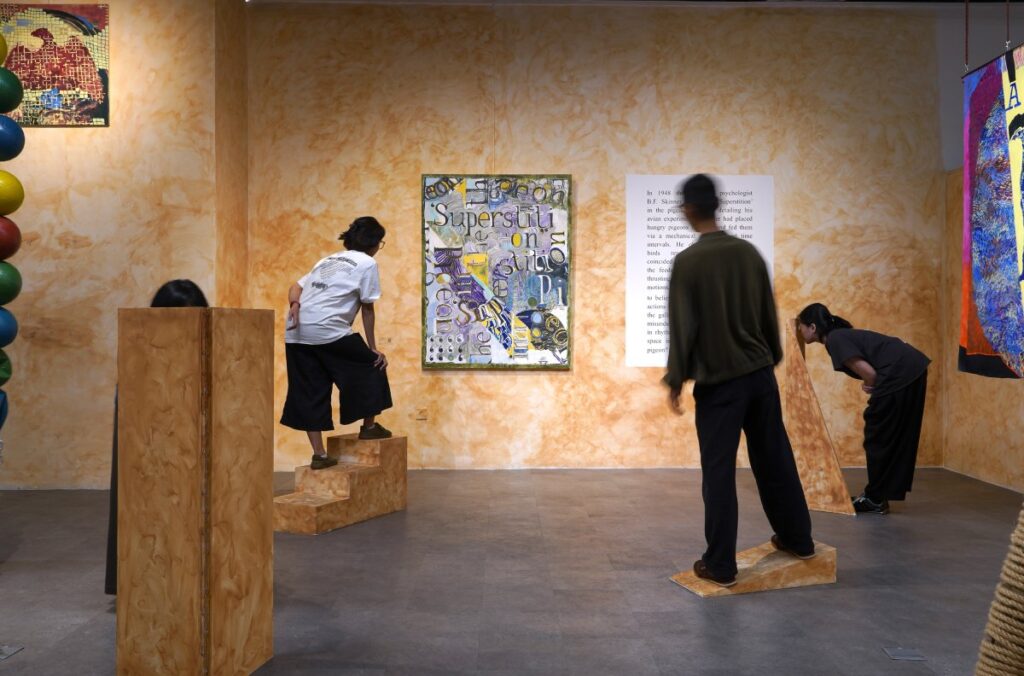
The paintings displayed at the HOARSE HORSE exhibition by Berlin-based artist Ida Lawrence do not behave like paintings. They hang, slack-backed and unstretched, as if they have shrugged off the polite posture of the gallery wall. Some are tethered with straps and rope; others carry hardware in the form of collars, leashes, and fastenings. The show is staged at ISA Art Gallery in Wisma 46, but the mood is homey and intimate. It feels closer to walking into a studio where the work is still deciding what it is, and you have arrived right into the journey.
Ida calls her works “story paintings”, a term that sounds tidy until you stand before the large diptych Artist Statement and realise the story refuses to behave. To her, the canvas is a sentient organism, shedding and mutating as it is made rather than waiting to be completed. She often begins with a fragment of story sparked by something from daily life like a sign that unsettles her or word that refuses to leave her. She allows it to grow into a narrative that is poured onto the surface.
But the story is never a script to be followed, Ida starts with only the loosest sense of direction and lets the painting divert her, even contradict her. What matters is watching it “come to life” and responding to what it becomes rather than what she first imagined. Ida admits, with the candour of someone who has watched their own plan fail in real time, that mistakes aren’t something she hides. When the words on a canvas begin to crowd each other, when a line runs out of space and has to break awkwardly, she does not correct the error. She lets it remain, visible, as proof that a thinking, doubting human body was present when the work was made. And in an age where many are using Artificial Intelligence to create “art”, these imperfections become marks left by the human soul.
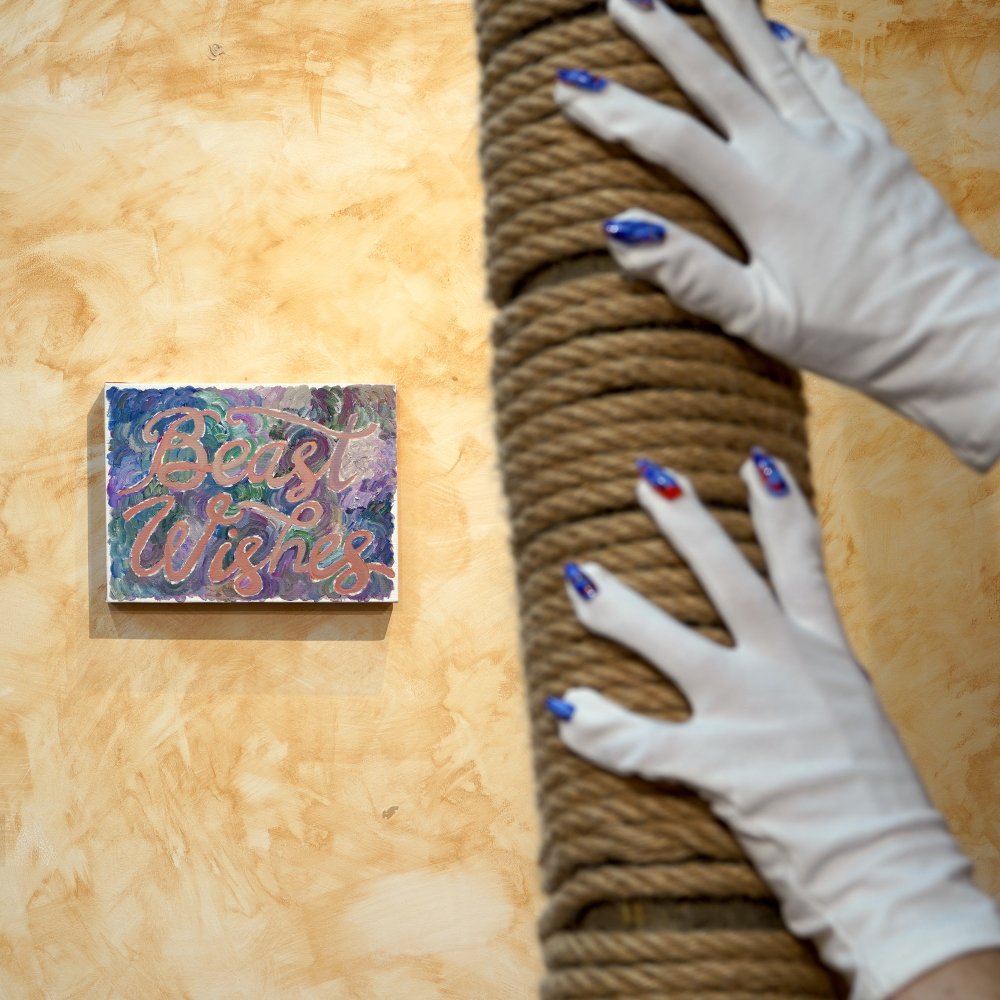
From this openness to misfit and interruption comes the exhibition’s embrace of linguistic slippage. That same drift of sound and meaning gives the exhibition its title, HOARSE HORSE, born from a children’s camp group that she led, where they repeated “horse” until it slipped into something else. Language plays a prominent role here. Instead of merely explaining the artwork, it becomes its co-conspirator.
Her Artist Statement (2025) is the clearest declaration of this approach. It refuses the usual hierarchy of support material– “This exhibition is accompanied by a film by Monika Proba, or perhaps it is the other way around” –and unfolds as a story painting. The text drifts through a humid 2011 Yogyakarta, noting sheep grazing on campus, a ricefield humming at night, tokek in the ceiling, chickens loitering for scraps, a snake found by an unlucky visitor locked in a bathroom. Even the footnotes participate in the narrative. Instead of dutiful academic ballast, they behave like dares. YouTube links, maps, short films, a school warning about jam belajar, a rabbit hole of references you can follow until you forget what you were “meant” to learn.
The many animal references scattered across the Artist Statement hint that these creatures occupy a central place in this exhibition. Foxes, dogs, birds, snakes, sheep drift through scenes of daily life, they belong as much to her inner worlds as to the physical environments she has lived in, carrying traces of Yogyakarta, Berlin, and elsewhere. In this way, the animals anchor the artist’s wider narratives about displacement, observation, and the human urge to find ourselves in what we see.
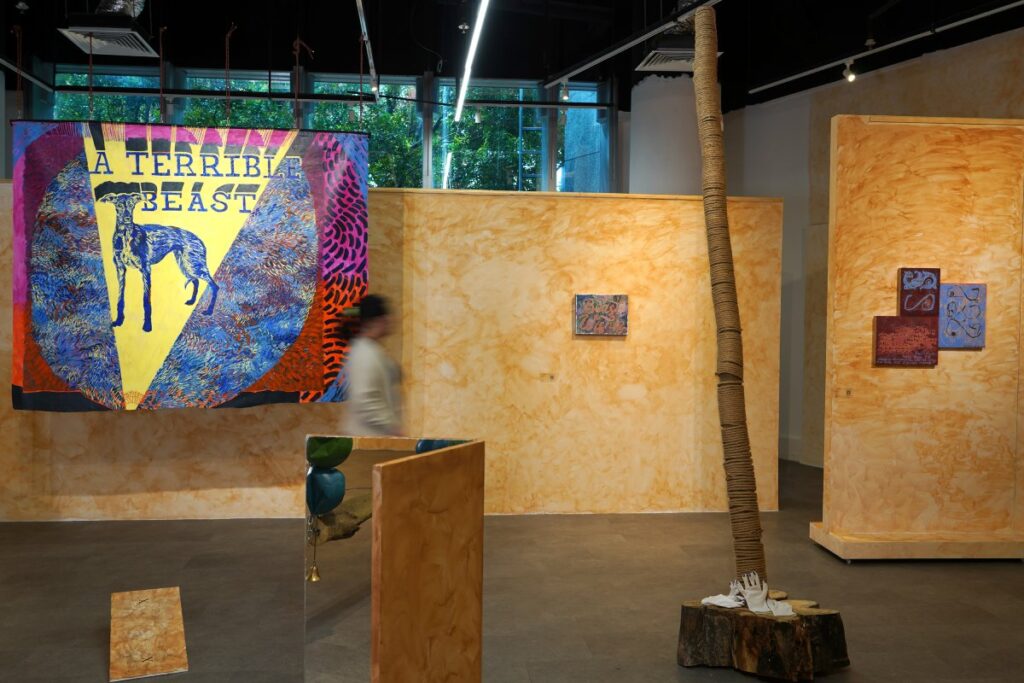
Projection becomes literal in A Terrible Beast (2021–2025), a large unstretched work held together with handstitching, straps, rope, and metal parts (similar to a dog’s leash). It announces itself like a warning sign, then undercuts its own authority with the phrase “TO PROJECT ONTO.” The humour is not that the dog appears harmless, but that the audience arrives ready to make it mean something. Ida speaks of mascots, national animals, and the way fables train us to read creatures as shorthand for human traits: sly fox, loyal dog, noble eagle. Yet these animals, she reminds us, are simply living their lives. The qualities we attribute to them are not theirs, but ours. We recognise ourselves in them, then pretend the reflection belongs to the animal. Which raises the question, if we identify with these projected beasts, what does that say about the way we understand ourselves?
That question continues in the three-panel Karla’s Fox Story (2023–2025). The line “and do you know how I knew it was a fox who’d stolen my shoes?” carries the rhythm of a joke held just long enough to unsettle. The fox stands with a pair of shoes, painted with almost childlike directness, as if the theft were a costume change. Lawrence welcomes interpretation, but she remains wry about the human need to fix meaning. Sometimes the work simply holds the story open.
The Eagle and the Net (2025) sets a bird form behind a crude lattice, the paint dragged into a grid, beneath it, the text asks: “But does the net keep something out, or the eagle in?” It is a simple line that starts to feel less simple the longer you stay with it. Jakarta knows its own versions of nets: rules claim to protect, barriers claim to organise, polite boundaries suddenly becoming cages. Ida does not labour the point, she lets the question hang in the air, where it nags at your brain.
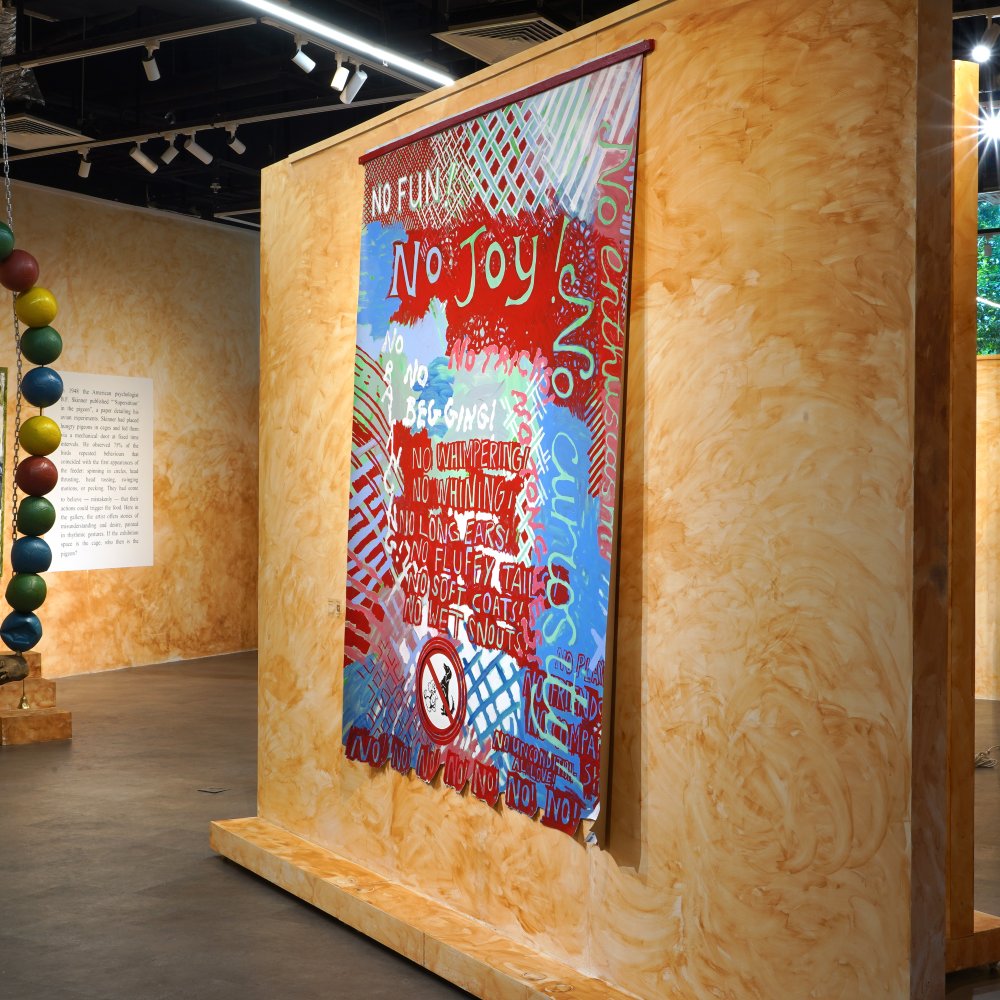
The funniest painting here is also the one that comes closest to a kind of rage. No Fun No Joy (2025) begins with a “no dogs” sign, something that’s common in Indonesia, but rare Germany, where dogs are generally allowed into shops. She deliberately misreads it, and the misreading expands into a relentless litany: “NO LONG EARS! NO FLUFFY TAILS! … NO FRIENDSHIPS! NO COMPANIONSHIPS! NO UNCONDITIONAL LOVE!” The surface is loud with warning-red, the typography crammed and forced into awkward breaks, and the repeated “NO! NO! NO!” starts to sound less like signage and more like a person trying to talk themselves out of needing anything. Lawrence points out the places where the wording doesn’t fit, where a line buckles. Those buckles matter. They are the point at which the painting admits it is made by someone with limits.
In the end, the animals remain what they were at the start. They’re not symbols to decode, but accomplices in human habits—projection, misreading, the urge to make stories out of what we cannot control.
Thirteen pieces of her work hang, perch and appear to move through the gallery space, but the movement that matters happens inside the viewer. You might come here expecting to see adorable animal paintings, but you might also leave noticing how quickly you turn anything into a reflection of yourself. Ida’s trick is that she gets you there by making the space feel light on its feet. She lures you with colour and humour, then once you are already inside, she lets the questions start doing their work.
This exhibition was exhibited at ISA Art Gallery until 7 February 2026. For more of Ida Lawrence’s work, visit her website.
ISA Art Gallery at WISMA 46 – KOTA BNI
Jl. Jendral Sudirman Kav. 1
Tanah Abang, 10220
Jakarta, Indonesia
+62 811 1317 023
isaartanddesign.com