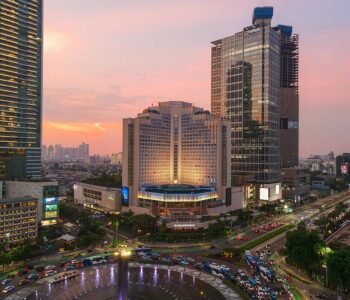



Before glass towers defined Jakarta’s skyline and long-haul jets redrew the map of Southeast Asia, there was Kemayoran, a place where Indonesia first stepped onto the global stage.
Long before modern airports reshaped the nation’s horizons, Kemayoran in Central Jakarta served as Indonesia’s primary gateway to the world. More than a city district or a cultural footnote rooted in Betawi heritage, Kemayoran was a hub for international arrivals and departures, where the story of Indonesian aviation quietly took flight.
On 6 July 1940, a Douglas DC-3 Dakota descended onto a freshly laid runway in the very heart of Batavia. Operated by the Dutch East Indies airline Koninklijke Nederlandsch-Indische Luchtvaart Maatschappij (KNILM), the aircraft had departed from the joint military and commercial Cililitan Airfield, now known as Halim Perdanakusuma International Airport. After its smooth landing at Kemayoran, the aircraft continued to Australia the following day.
It was a momentous occasion in the country’s aviation history. The DC-3 was the first aircraft to land at Kemayoran Airport, doing so two days before its official inauguration on 8 July 1940. Construction of the 454-hectare complex had begun in 1934 under Dutch colonial administration. Designed to meet international standards, the airport featured a north–south runway measuring 2,475 by 45 metres and an east–west runway of 1,850 by 30 metres, making Kemayoran the Dutch East Indies’ first purpose-built international airport.
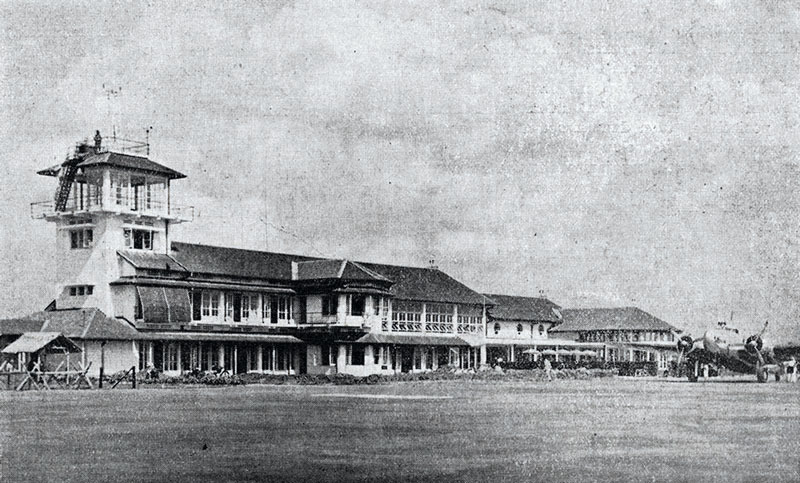
Scheduled flights linked cities across the archipelago with destinations in Southeast Asia and Australia. DC-3 Dakotas were regular visitors, joined by other Douglas-manufactured aircraft, reflecting Kemayoran’s strategic role in regional aviation at a time when air travel was still an enterprise of daring and prestige.
Only weeks after its opening, Kemayoran Airport staged one of its earliest spectacles. On 31 August 1940, it hosted its first air show to mark the birthday of Queen Wilhelmina of the Netherlands. Civilian aircraft operated by KNILM shared the skies with private planes from the Aero Club Batavia, including the Bücker Bü-131 Jungmann, de Havilland DH-82 Tiger Moth, Piper Cub, and Walraven W-2, a vivid demonstration of modernity and aeronautical ambition.
For the next four decades, Kemayoran served Jakarta’s principal aerial gateway. Yet as the city expanded relentlessly around it, the airport’s central location became a liability. Rising population density and urban congestion increased operational risks, and on 31 March 1985, Kemayoran Airport officially ceased commercial flight operations. Air services were transferred to Soekarno-Hatta International Airport and Halim Perdanakusuma, marking the end of an era.
Before disappearing entirely into the urban fabric, Kemayoran enjoyed a brief final flourish. In the mid-1980s, the former runway became a testing ground for Indonesia’s CN-235 aircraft and the venue for the final Indonesia Air Show in 1986. Featuring aircraft from 22 countries, the event provided a fitting curtain call for one of Jakarta’s most storied landmarks.
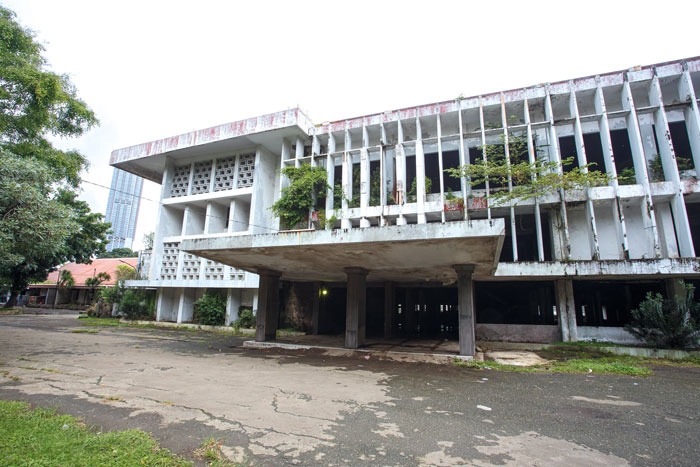
Today, the airfield survives in fragments. Managed by the Kemayoran Complex Management Centre (PPK) under the Ministry of State Secretariat, its runways have been repurposed as major thoroughfares, most notably Jl. Benyamin Sueb, named after the legendary Betawi artist. The former airport grounds now host JIEXPO Kemayoran, a vast civic and exhibition space that welcomes concerts, trade fairs, and the annual Jakarta Fair, held to celebrate the capital’s anniversary, alongside a rapidly growing urban district.
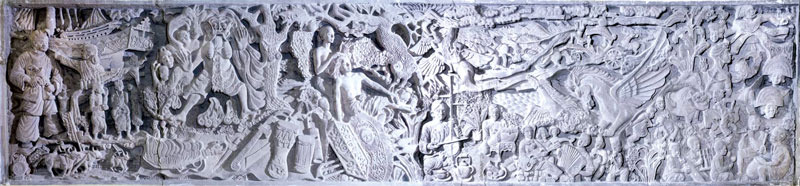
Physical reminders of Kemayoran’s aviation past remain, though many are neglected. Among the most striking is a series of relief panels located in what was once the VIP and state guest waiting area, now accessible only by appointment. Commissioned in 1957 by President Sukarno, who had a strong affinity for three-dimensional art, the reliefs were created by leading Indonesian artists Sindoedarsono Sudjojono, Harijadi Sumodidjojo, and Surono, assisted by their students from the Young Indonesian Artists group.
The three panels depict the West Javanese legend of Sangkuriang, scenes of Indonesian daily life, and the flora and fauna of the archipelago—a visual narrative intended to introduce Indonesia’s identity to international visitors.
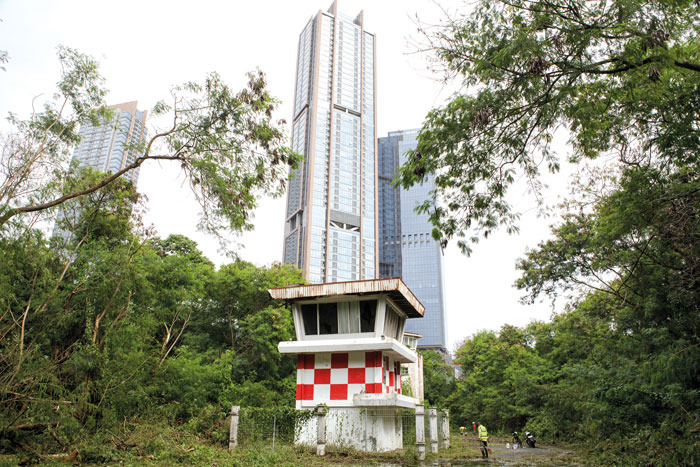
Standing nearby is another enduring witness to Kemayoran Airport’s former grandeur: the Air Traffic Control Tower. Known as the Kemayoran Tower or the Tintin Tower, it is recognised as the first ATC tower in Southeast Asia. Its cultural afterlife extends far beyond aviation history. In 1968, the tower appeared in “Flight 714”, a “Tintin” adventure by Belgian comic artist Hergé, in which Tintin and his companions land at Kemayoran International Airport—a moment that immortalised the airport in global popular culture. Today, the tower still rises among modern apartment blocks, instantly recognisable by its red-and-white façade and distinctive chequered pattern.
Kemayoran’s story, however, did not begin with aviation. The name “Mayoran” appeared as early as 1816 in the Java Government Gazette, referring to land near Weltevreden, Batavia’s European administrative centre. The property belonged to Isaac de l’Ostal de Saint-Martin (1629–1696), a Frenchman in the service of the Dutch East India Company (VOC), whose official rank was mayor. The title that would, over time, give the district its name.
“Kemayoran was modest in size, covering only 30 morgans (a European unit of land measurement, with one morgan equivalent to approximately 0.8565 hectares), and was once under the control of Major Isaac. Its boundaries stretched from what is now considered Kemayoran’s zero point on Jl. Garuda to the end of Jl. Angkasa,” recalled Ahmad Suaib, better known as Bang Davi, a respected cultural figure and a fifth-generation native of Kemayoran.
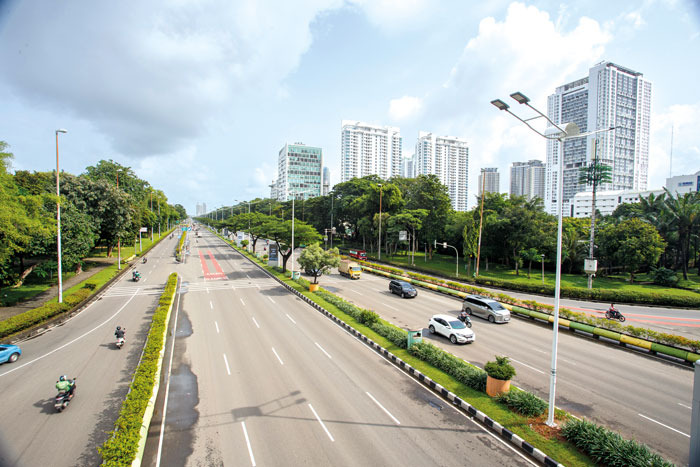
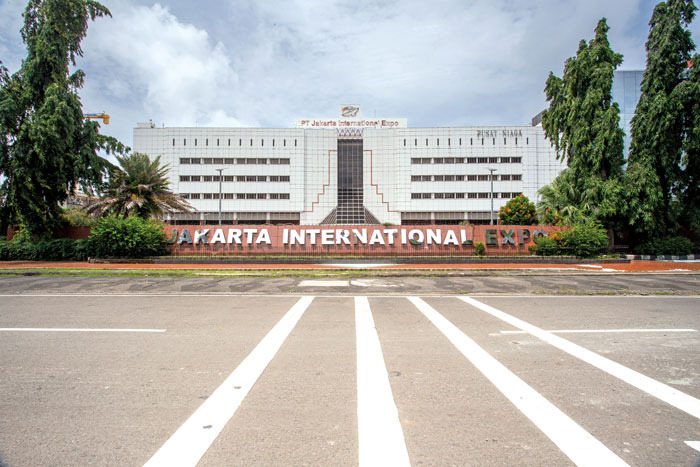
Photos by Des Syafrizal.
According to Bang Davi, Jl. Garuda marks the true beginning of Kemayoran. It was here that early processes of assimilation took place, with many Dutch soldiers marrying local women. From these unions emerged the terms sinyo and noni, used to describe men and women of mixed European and local descent. Today, Jl. Garuda has taken on a very different character, having evolved into a well-known culinary strip particularly famous for pempek, a traditional dish from Palembang that has, somewhat unexpectedly, become abundant in the area.
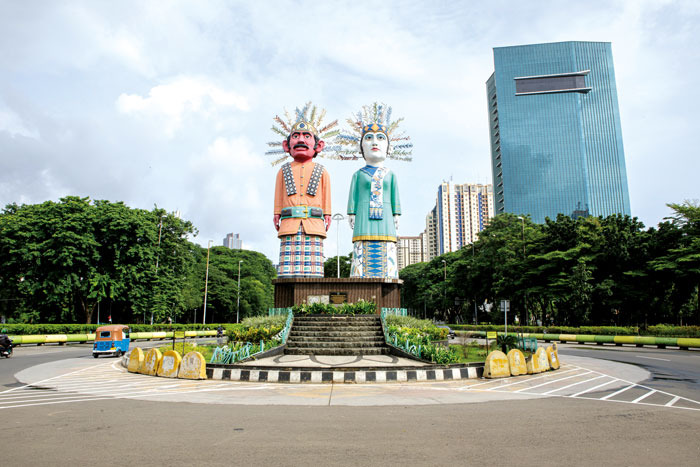
Bang Davi further explained that Kemayoran has long been recognised as a stronghold of Betawi culture, where the ondel-ondel (traditional giant puppets) began. However, a closer look at its earliest history reveals that the area was initially inhabited by the Saketi people, communities from Banten who arrived as part of the spread of Islam. Many of these early settlers established themselves in what is now the Serdang area, while Betawi communities became more concentrated in Jiung and Utan Kayu.
Kemayoran, he noted, stands as a clear example of Betawi openness; a place where local communities historically lived harmoniously alongside newcomers. Yet the contemporary portrait of Kemayoran tells a different story, with migrant communities now forming the majority and reshaping the area’s social fabric.
“Kemayoran was once a complete place,” Bang Davi recalled. “It was a meeting point for community leaders, religious teachers, writers, artists, and even political figures.”
This legacy is reflected in the name Kemayoran Gempol, an abbreviation of gembong politik (political kingpin), signifying the area’s former role as a hub of political thought and mobilisation.
It was in Kemayoran that the idea of Indonesia’s proclamation of independence was born. Young activists and political figures such as Chaerul Saleh and AM Hanafi gathered here, later intercepting Sukarno and Mohammad Hatta at Kemayoran Airport to urge them to immediately declare independence.
“But Kemayoran today is no longer the Kemayoran of memory,” Bang Davi concluded, “Its historical weight remains, yet much of its soul now lives only in stories.”
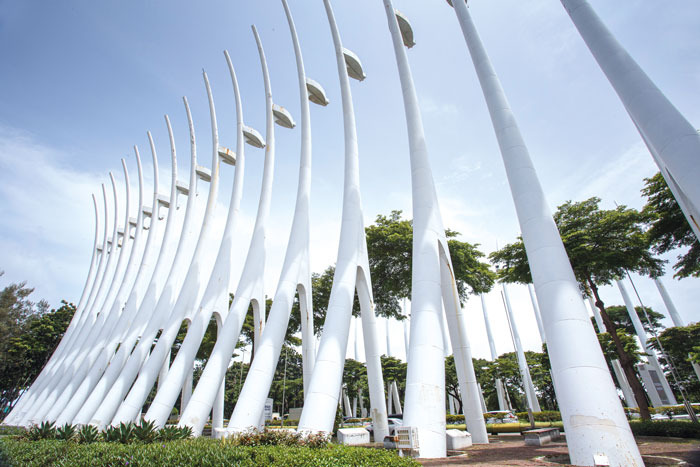
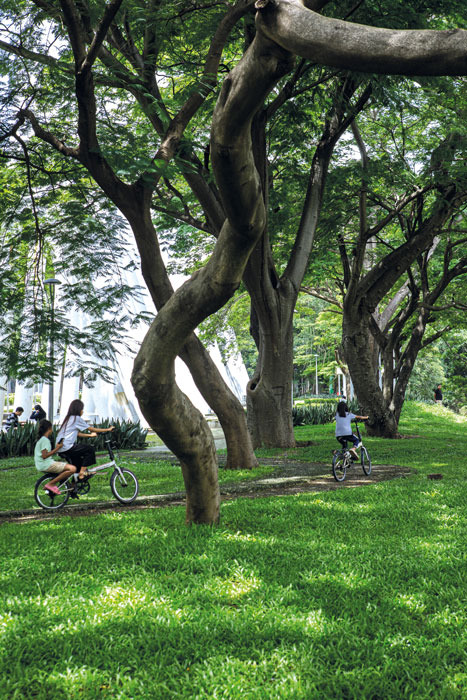
(Left) The main entrance to Kota Baru Bandar Kemayoran (KBBK) is situated to the north of Jalan Benyamin Sueb. Each gate post rises 40 metres high, forming a striking landmark within the district. Enhanced by colour-changing reach lamps, the illuminated structure creates the dramatic impression of passing through a grand archway when entering the Kemayoran Main Gate. (Right) One side of the Kemayoran city forest. Photos by Des Syafrizal.
Kemayoran continues to stand at the uneasy intersection of modern ambition and unresolved social realities. The area feels decisively split: one side defined by overcrowded neighbourhoods and long-standing informal settlements, the other by a northern corridor that has been meticulously reshaped into an international-scale commercial and business district, softened by green spaces called Hutan Kota Kemayoran.
In this northern zone, elite residential enclaves rise with confidence, while luxury apartment towers, international schools, corporate offices, and high-end hotels form a landscape that appears almost detached from its immediate surroundings. Alongside JIExpo, the Aula Simfonia concert hall has emerged as a cultural counterpoint, offering world-class orchestral performances to a distinctly urban and cosmopolitan audience.
This divide is not merely social, but spatial and symbolic. It is marked physically by 34 imposing pillars, 17 to the west and 17 to the east, leading to a monumental 40-metre-high gate that stands as both a welcome and a threshold. Beyond it lies a version of Kemayoran that looks decisively forward, even as the older, denser quarters remain just steps away, carrying histories and challenges that modern development has yet to resolve.