


Building on the foundations developed in Early Years, Mrs. Jo Osman, Head of Primary at British School Jakarta, shares how curiosity-based learning and an integrated wellbeing approach helps to develop creative, compassionate and resilient students at the primary school level.
Mrs. Osman, thank you for taking the time to speak with us. Would you please share a little background on yourself before we dive into the details?
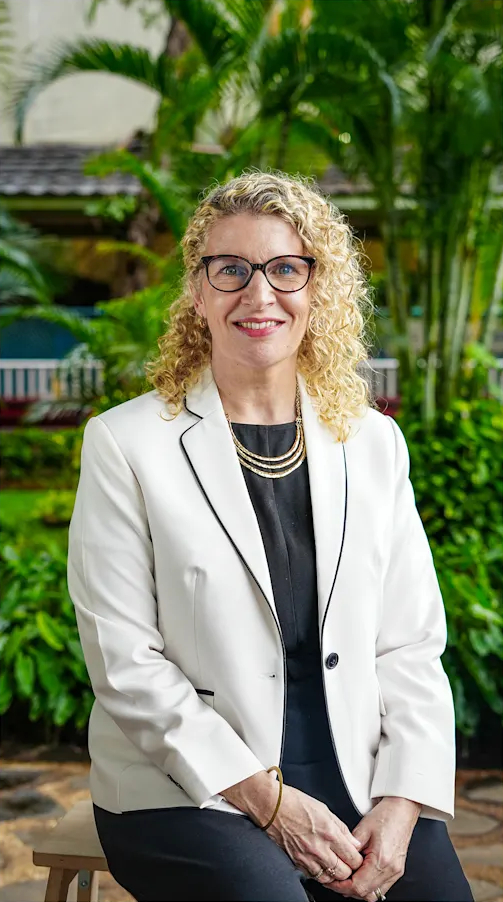
Of course, my name is Jo Osman, and I am the Head of Primary here at British School Jakarta (BSJ). I am originally from the UK, but I have been in Asia for over 20 years. Whilst I only started in this position in August, this is not my first tour in Jakarta. I was previously at BSJ for six years – from 2008 to 2014. In between I was at Tanglin Trust School, Singapore.
And how does it feel to be back at BSJ?
Absolutely amazing. It feels like I have come home.
What was one of the main draws of returning to BSJ as Head of Primary?
It was actually BSJ’s implementation of wellbeing education; this was one of the things that attracted me to come back. My Masters was about wellbeing in education and how leaders can support staff so that the children can then have the very best experience. When I heard what Andrea Downie, Head of Wellbeing at BSJ, was implementing here, I was intrigued.
Whilst wellbeing is part of the curriculum, and there is a scope and sequence that develops as students move up the school, it is far more than that here at BSJ – it is actually threaded through everything we do.
What does wellbeing look like on a day-to-day?
There is often this misconception that wellbeing is just about feeling happy, and that is absolutely not the case. We do, of course, explicitly teach children emotional literacy, so they can understand, self-regulate and express their own feelings and needs, as well as understand others. But our aim is also to build children’s skillsets proactively, encompassing 8 different aspects of wellbeing. This way they learn how to thrive in any environment, including when faced with adversity and challenge.
The school believes that, rather like gardeners, our role as educators is to cultivate the conditions for students to flourish, building their strengths and resilience. We know they cannot thrive in academic learning if they are struggling in their personal and social spheres. When they go out into the world as young adults, they will certainly need these skills to adapt to a world that is constantly changing.
I am sure academics remain important as well – what curriculum is adopted at the Primary level?
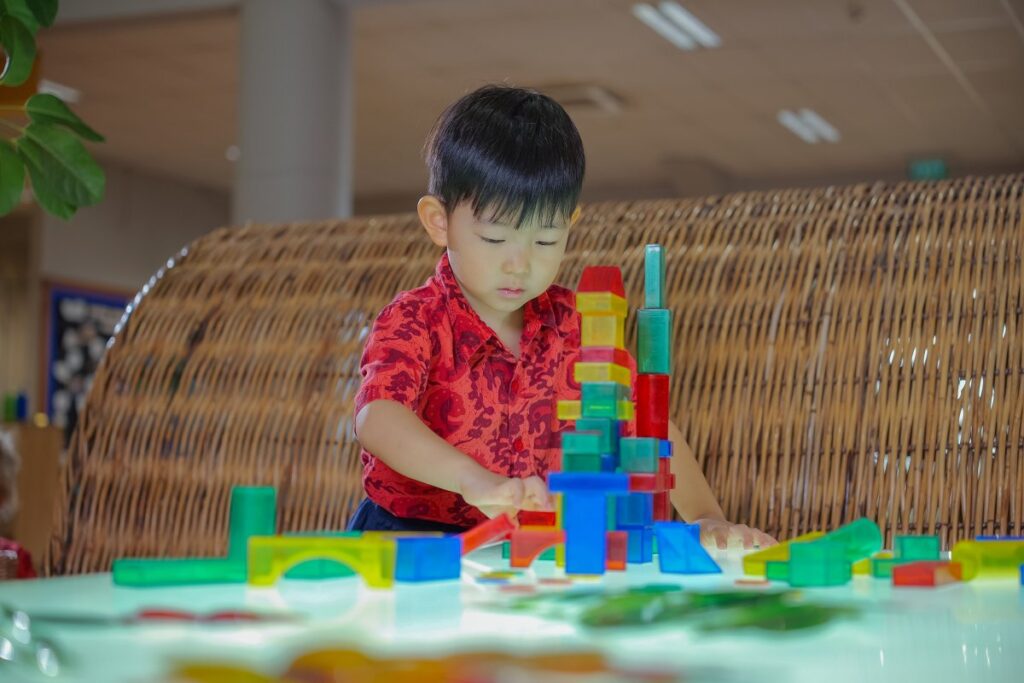
For English and Maths we follow the English National Curriculum, following schemes from the UK which gives us the required academic rigour and high expectations. For the rest of the curriculum, we follow an adapted version of the International Primary Curriculum (IPC), which is linked to the English National Curriculum but adapted to our context. It is very well suited to international settings like BSJ, meeting the needs of children who are truly global citizens. We deliver the curriculum using a curiosity-led and inquiry-based approach, ensuring children are able to apply their lessons across different contexts, deepening their learning in ways that excite and engage them. We believe wholeheartedly in developing the whole child, and so beyond the curriculum we also offer trips, special events and hundreds of extracurricular activities that the children can participate in.
You mentioned curiosity-based learning, what is this approach exactly?
The Curiosity Approach is an accreditation from the UK and it’s based on Early Years best practice, gathering research from a range of international examples, including Reggio-Emilia, Montessori and New Zealand’s Te Whāriki.
In more traditional modes of education, children would be passive learners, expecting the teacher to tell them what to do and deliver knowledge. A curiosity-based or inquiry-led approach is an active learning model, where children have voice, choice and ownership over their learning, ensuring they grow in independence and are fully engaged with the process. Crucially, they ask curious questions, think critically about their learning and are excited to challenge themselves.
We have always had very good academic results at BSJ, but that is not enough on its own.
To be honest, with technological development, knowledge is likely to be delivered in a different way in the future. So, what our students will definitely need are critical thinking skills, the ability to collaborate, and a great deal of creativity and resilience to solve the problems that arise. We want students who are compassionate and go out into the world and make a real difference for us all.
Are the students assessed at all during their time at Primary School?
Of course, they are assessed every single day! Teachers are finding out what students are capable of and setting new targets in every lesson, although these are generally low stakes in the form of quizzes, tasks and observations. The children are taught to self-assess too, identifying their own strengths and next steps. We also have what we call summative assessments; these are group-based tests in the core subjects of Maths and English at regular intervals, which we use to benchmark our outcomes against UK and international standards. This ensures that we never lose touch with what excellence looks like in a high-quality education.
We strive to measure what we value, rather than value what we measure. By the time they get to secondary school, the aim is that children are really clear what steps they need to take to achieve success, both academically and personally.
Speaking of the learning environment, how does that play an important role in the student experience?
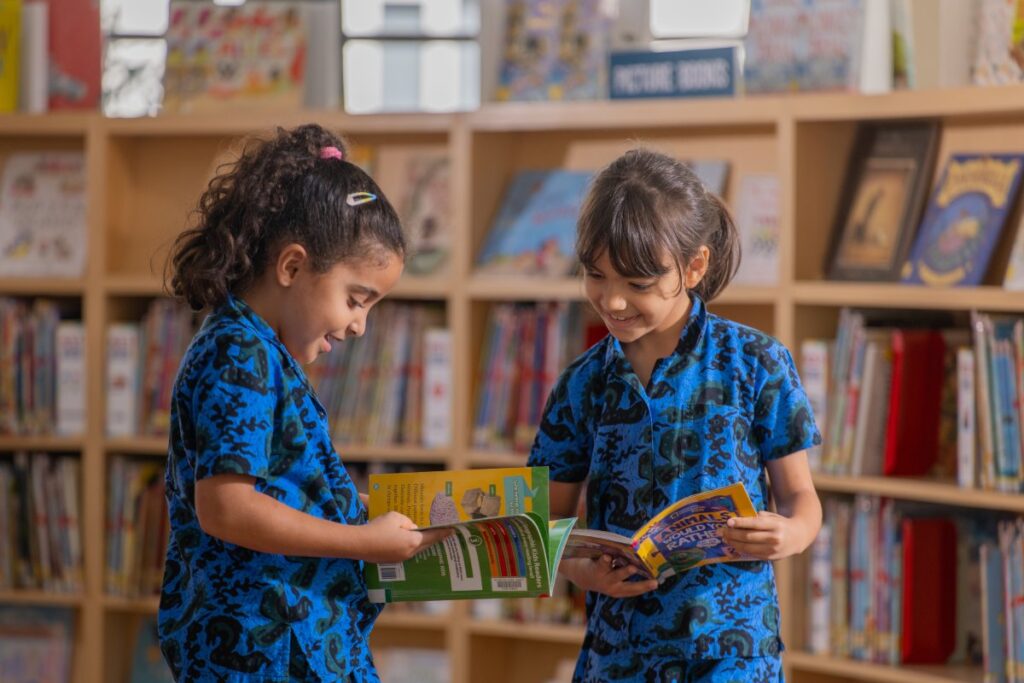
We gather the children’s view on their learning environment at the start of each academic year and try to cater to all learning preferences, from quiet spaces to concentrate, through to collaborative learning spaces. We have flexible working spaces for that reason all the way through the school.
Students will also have specialist lessons and we offer world-class bespoke spaces for these, whether for music, sports, Indonesian studies or the arts.
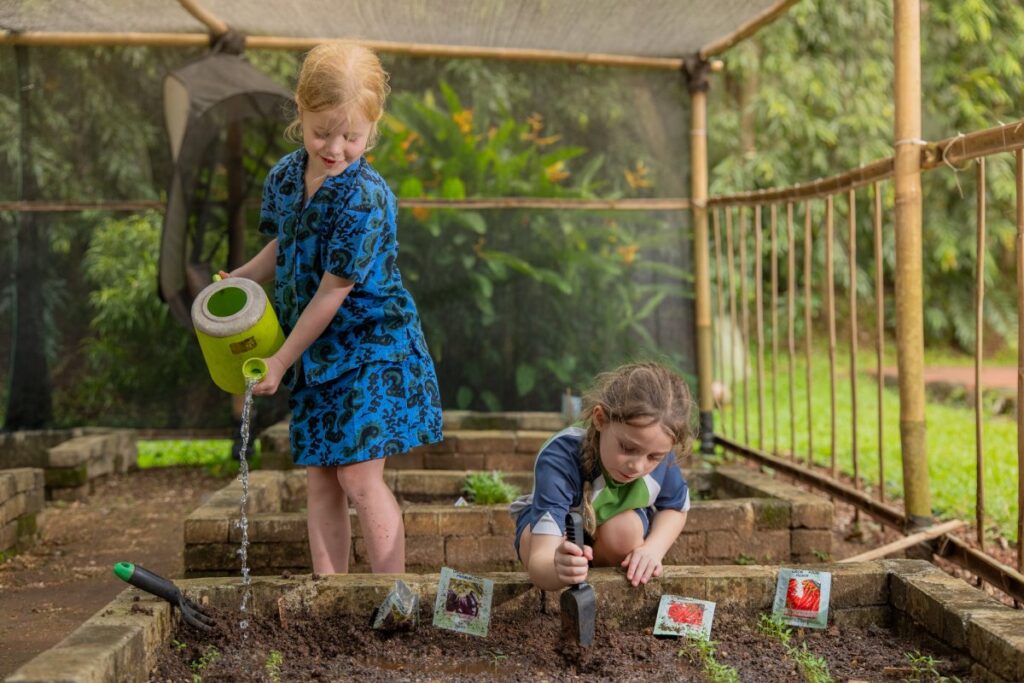
We are also currently developing a forest school on a beautiful part of our leafy campus, which will bring children authentic learning experiences within nature. We live in
a sprawling concrete jungle here in Jakarta so it is quite hard to find natural environments for the children to explore, take managed risks and solve problems collaboratively. Watch this space!
As the Head of Primary, what kind of students do you hope to foster at this stage of their education?
I’d like to see them as kind, confident, collaborative, critical thinkers who take away a lifelong love for learning. They love coming to school every day, and we want them to go into the secondary school feeling ready for anything. That’s when we know we have done our job well.
Do we want them to hit the academic objectives for their age? Yes, of course, but not at the expense of their wellbeing, resilience or relationships. We endeavour to make sure that they are developed as well-rounded human beings and give them every opportunity to discover what they excel at and what gives them joy. So, as they go into secondary school, they know very much who they are – they have a strong sense of identity, but also, a strong sense of belonging here at BSJ.
British School Jakarta
Bintaro Jaya, Jl. Jombang Raya Sektor 9, Pd. Pucung
+62 (21) 8082 8140
bsj.sch.id