



This is the eighth in the Ambassadors Round Table Series with NOW! Jakarta Founder Alistair Speirs meeting and interviewing ambassadors from all over the world to find out the breadth and depth of their country’s relationship with Indonesia.
Having covered much of North, South America, and many countries in Europe it was time to come closer to home and seek out the ASEAN Ambassadors. So in this issue we meet the very personable, friendly and experienced ambassadors from Malaysia and Thailand and get up to date with their programs.
Introducing the Ambassadors:
H.E. Dato’ Syed Mohamad Hasrin Tengku Hussin (DSMH)
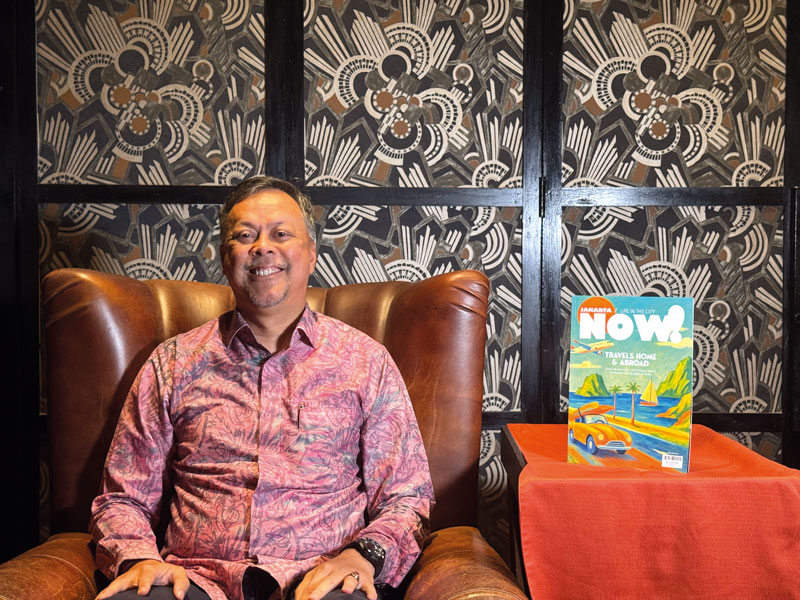
Ambassador of Malaysia to The Republic of Indonesia received his credentials from the President of the Republic of Indonesia, H.E. Ir. H. Joko Widodo on 26 June 2023.
Dato Hasrin has served in the Permanent Mission of Malaysia to the United Nations, as Consul General of Malaysia in Dubai and Deputy Chief of Mission at the Embassy of Malaysia in Jakarta from 2010 until 2013. He was Ambassador of Malaysia to the United Arab Emirates from 2017 until 2019; and Ambassador and Permanent Representative of Malaysia to the United Nations, New York from 2019 until 2023.
He holds a Master Degree in Public Management from the Lee Kuan Yew School, National University of Singapore (NUS) and Bachelor of Arts (Hons.) in Political Science from the University of Arizona.
H.E. Mr. Prapan Disyatat (PT)

Ambassador of Thailand to The Repubic of Indonesia has a Bachelor of Economics from the Australian National University, Australia, Master of Arts (International Economics), Ohio State University, USA and Doctor of Philosophy (International Economics), Ohio State University, USA.
He joined the Ministry of Foreign Affairs in 1991 before moving to Royal Thai Embassy, Vientiane, Lao PDR 2001 – First Secretary, Royal Thai Embassy, Vientiane, Lao PDR in 2000 then Royal Thai Embassy, Washington D.C. in 2007. He became Minister- Counsellor, Royal Thai Embassy, Seoul, Republic of Korea in 2014 before becoming Ambassador attached to the Ministry, Office of the Permanent Secretary in 2021, Ambassador of the Kingdom of Thailand to the Republic of Indonesia in 2022 and took up his post as present.
Highlight Interview Questions
AGS: What have been the high points in the relationship between your country and Indonesia over the years? Were there any breakthrough moments that stand out?
DSMH: Malaysia and Indonesia have an understanding relationship that predated the formation of both nations, which is based on shared cultural, linguistic, and family ties. After Malaysia gained independence in 1957, Indonesia was one of the first countries to recognise and establish diplomatic ties with us.
In addition, Malaysia and Indonesia are among the five founding members of the Association of Southeast Asian Nations (ASEAN). ASEAN has been a cornerstone of regional diplomacy and also serves as a platform for enhancing Malaysia-Indonesia cooperation.
Bilateral trade has expanded significantly, with numerous joint ventures and economic cooperation, such as the Indonesia-Malaysia-Thailand Growth Triangle (IMT-GT) and Brunei Darussalam-Indonesia-Malaysia-Philippines East ASEAN Growth Area (BIMP EAGA). Both nations are major players in sectors such as the palm oil industry. In 2015, Malaysia and Indonesia jointly established the Council of Palm Oil Producing Countries (CPOPC) to coordinate production policies, counter discrimination and trade barriers from importing countries, set sustainability standards, improve yields, and promote environmental practices. The CPOPC now has five (5) members, including Indonesia, Malaysia, Honduras, DR Congo, and Papua New Guinea, and represents 86% of the global palm oil production.
The two countries also continue to collaborate on regional security, border patrols, and anti-terrorism efforts. Frameworks such as the General Border Committee (GBC) contribute to addressing transnational crimes and extremism.
On 8 June 2023, Malaysia and Indonesia signed the treaty relating to the delimitation of the territorial seas of the two countries in the southernmost part of the Straits of Melaka and the Sulawesi Sea. The agreements were concluded after affirming the desire of both countries to resolve the issue peacefully. In 1998, both countries requested the International Court of Justice (ICJ) to resolve the disputes over Ligitan and Sipadan Islands. Presently, both countries are continuing negotiations with regard to outstanding land and maritime issues through the existing bilateral mechanism.
In 2022, both countries almost met the target of USD30 billion in bilateral trade. Indonesia was the 6th largest trading partner for Malaysia globally and the second largest trading partner among ASEAN countries, respectively.
PT: The connections between the two countries and peoples can be traced back long to the ancient Kingdom of Sriwijaya, and between the Kingdoms of Majapahit and Ayutthaya. The peoples of the region of what is today Indonesia and Thailand are shaped by the common roots of Hinduism, Buddhism and Islam.
Certainly, the high point of our relationship is the formalisation of this relationship approximately seventy-five years ago. On 7 March 1950 the Republic of Indonesia and the Kingdom of Thailand established diplomatic relations with one another.
Another high point was when the region was mired in challenging political-security conditions, the collective drive of our two countries for peace, solidarity and cooperation in the region would prevail. We became the founding members of the Association of the South-East Asian Nations (ASEAN) in 1967.
More recently in May of this year, President Prabowo visited the Kingdom where he agreed with Prime Minister Paetongtarn to elevate our relations to become ‘strategic partners’.
What are the strongest elements in the relationship today? What are the factors and sectors that you are concentrating most on?
DSMH: The strongest element is the shared values that are based on cultural, linguistic, and family connections. Both nations are part of the broader Malay world (Nusantara). The national languages of Malaysia and Indonesia are based on the same root. The cultural similarities are an important foundation for both countries to continue to work together at the bilateral, regional, and global levels. Thus, enhancing connectivity is critical for the further strengthening of countries.
In 2024, Malaysia received 4.1 million visitors from Indonesia, an increase of 24% as compared to 2023. Indonesia received 2.2 million tourists from Malaysia in 2024. In addition, there are about 11,000 Indonesian students studying in Malaysia’s educational institutions.
Another priority is economic cooperation. Bilateral trade between Malaysia and Indonesia is robust, with both countries heavily involved in sectors such as palm oil, rubber, oil and gas, manufacturing, and banking. In 2024, bilateral trade increased by 4.5% to USD 25.50 billion (RM116.29 billion). Exports increased by 6.9% to USD11.92 billion (RM54.40 billion) while imports also increased by 2.6% to USD13.57 billion (RM61.88 billion). Both countries are working tirelessly to achieve the annual bilateral trade target of USD30 billion.
As for investment, based on the Ministry of Investment of the Republic of Indonesia, Malaysia was the country’s fourth-largest source of foreign direct investment in 2024 after Singapore, Hong Kong, and China, with a total investment of USD 4.2 billion. This marks an improvement from 2023, when Malaysia ranked fifth with an investment of USD 4.1 billion. The main sectors of investment are plantations, telecommunications, banking, and oil and gas.
PT: Thailand and Indonesia have enjoyed ‘zero wound and conflict’ throughout our longstanding friendship.
However, the most important focus of our relations, I would say, is the dynamic and ever-growing economic relations. This is reflected in our trade and investment numbers. Our trade volume stands at 18.6 billion US dollars, which of course, could be more. Indonesia is our 8th largest trading partner, the 3rd largest partner in ASEAN.
Thailand imports Indonesia’s oil, petroleum, coal and machinery parts while Thailand exports agricultural produces like sugarcane, rice, motor vehicles, parts and chemicals. Thai companies are also investing in Indonesia in the banking, mining, energy, chemicals, food, and construction sectors. New sectors for expansion include halal products, medical tourism and clean energy.
The strong bonds between our two countries also make our governments well-placed to tackle transnational crime. We are working to prevent trafficking in persons and intercepting the flows of narcotics.
At the people level, Thais know Indonesia and Indonesians know Thailand. Over 800 hundreds Thai students choose to study in Indonesia and over 870,000 Indonesians travel for tourism to Thailand last year. Thais are now visiting more of Indonesia beyond the usual tourism destinations.
In the short term, the Royal Thai Embassy is focused on commemorating the 75th Year Anniversary of our diplomatic relations with many activities including a concert, Joint-Cultural Performance with the Ministry of Culture, the Thai Film Festival, and the annual Thai Festival. The Embassy looks to invite the public to join us to celebrate through these events. Details will be posted on the social media of the Royal Thai Embassy.
https://www.facebook.com/rtejakarta https://www.instagram.com/thaiembassyjakarta/?hl=en
What about the future, where do you want to take the relationship in the future?
DSMH: Looking to the future, I see great potential for both countries to expand the partnership that not only benefits both countries but also shapes the trajectory of Southeast Asia.
Malaysia and Indonesia should look into deepening economic integration, particularly cross-border cooperation and enhancement in the halal economy, digital and creative economy, food and energy security, renewable energy, and circular economy. Malaysia should also work to attract more investment from Indonesia, while leveraging on Indonesia’s new capital Nusantara, with Malaysian investment in infrastructure and services.
Both countries should continue to lead the sustainable palm oil agenda together by making CPOPC a global benchmark for sustainable commodity governance. Through CPOPC, both nations can shift the narrative from deforestation to responsible development and toward meeting sustainable development goals, including poverty eradication and rural development.
Following the signing of two treaties relating to the delimitation of the territorial seas of the two countries, we hope that the negotiations on the remaining and outstanding land and maritime boundary issues, including the intertidal area in the east of Pulau Sebatik and the gap from the low water line to Point M, can be resolved in due time.
As the founding fathers of ASEAN, it is important for both countries not to be complacent and continue to work closely together to further strengthen bilateral ties between the two nations, as the vitality of bilateral relations between Malaysia and Indonesia is essential to regional stability.
PT: Just in May 2025, our leaders have pledged to strengthen cooperation in order to support each other to achieve our respective national strategies, namely Thailand’s National Strategy (2018-2037) and the 2045 Golden Indonesia Vision.
The Thai-Indonesian Strategic Partnerships will focus on three key areas and promote energy, food and human security.
Political and Security Cooperation – Our countries continue to face common security challenges in the region. We will promote collaboration between law enforcement agencies to address transnational crimes, cybercrimes, and mutual legal assistance; enhancing engagement between defence agencies, including cooperation in the defence industry.
Economic Cooperation – Today, we are the two largest economies in Southeast Asia. Resilient supply chains between Thailand and Indonesia can harness our strengths to become centres of manufacturing and production, including for electric vehicles. We intend to deepen trade and investment ties, promoting food security, energy security, standardisation of the Halal industry, tourism collaboration, energy security, green growth, and the digital economy.
Socio-Cultural Cooperation – We will be enhancing collaboration in development cooperation, promoting education through student and academic exchanges, advancing science and technology cooperation, enhancing cooperation in healthcare, culture, creative economy, and strengthening people-to-people ties.