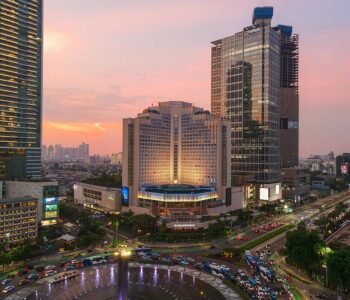



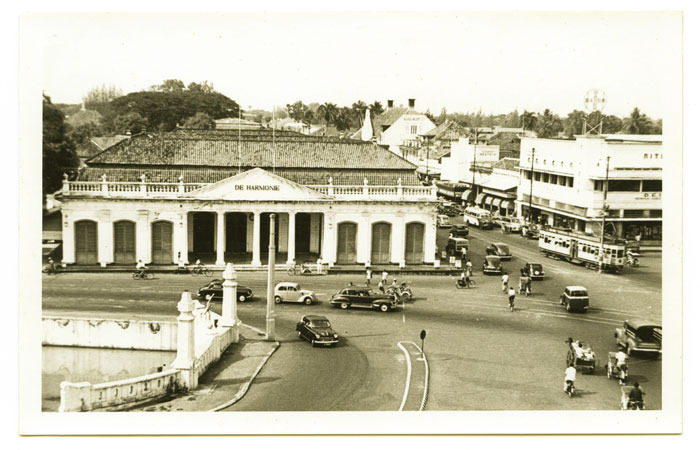
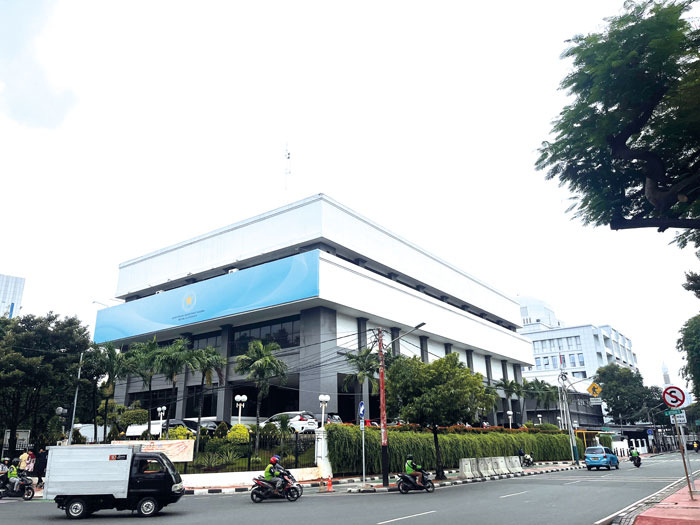
One of these days when exploring Jakarta, you might come across Harmoni’s nonstop traffic, and see hurried civil servants coming in and out of the unassuming area of the Ministry of State Secretariat. What is now a governmental zone, used to be the epicentre of Batavia’s high society, where the grandest balls and most exclusive club gatherings in the Dutch East Indies were held.
Opened officially on 18 January 1815, the Harmonie Society, or Societeit de Harmonie, was the most exclusive address in Batavia. The building, known as the Harmonie Club, hosted the Society’s social, cultural, and diplomatic functions, making it an exclusive central institution of European elite life. It was located at the corner of Jalan Majapahit and Jalan Veteran, firmly within what was then Batavia’s “uptown”.
The story behind the building began under Governor-General Daendels in 1810, when architect J.C. Schultze, who was also credited with the Gedung Kesenian (Jakarta’s historic theatre near Pasar Baru)—was commissioned to design a clubhouse capable of rivalling the Freemasons. The walls were built using bricks from the old Batavia fortifications to symbolise the shift of power from the fortified coast to a refined capital.
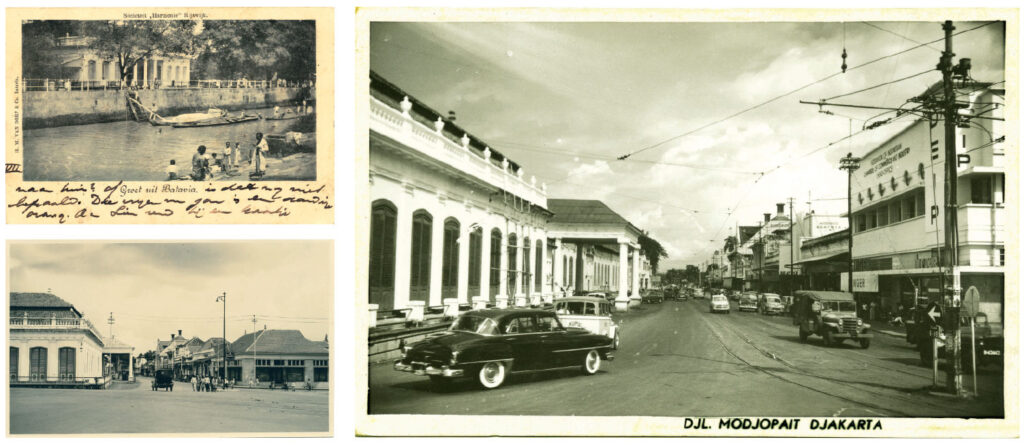
Photo credits, same order: Greetings from JAKARTA: Postcards of a Capital 1900-1950 by Scott Merrillees; JAKARTA: Portraits of a Capital 1950-1980 by Scott Merrillees; Greetings from JAKARTA: Postcards of a Capital 1900-1950 by Scott Merrillees
This was also part of a deliberate effort to pull European residents away from the ageing old city centre in the north (what is now Kota Tua area) and lure them into the newly fashionable southern district of Weltevreden— centred on the areas around today’s Lapangan Benteng, Medan Merdeka, Jalan Veteran, and Jalan Juanda. This ambition was reflected in the club’s imposing Neoclassical architecture. And despite the British takeover in 1811, construction continued under Sir Stamford Raffles, with the final cost ballooning to 360,000 rijksdaalders, an enormous sum for its time.
The club then quickly became the setting for major celebrations, hosting Dutch cultural fairs, the city’s 250th anniversary in 1869, and countless society galas. After Indonesian independence, Indonesian citizens were finally able to walk freely beneath its ceiling. The once-exclusive ballroom hosted weddings, concerts, diplomatic receptions, and even a visit from India’s Prime Minister, Jawaharlal Nehru. In 1954, the club’s name was changed to the Djakarta Club, distancing itself from its colonial past.
But the city’s planners in 1985 had a different direction for the Harmonie Club. From March to April that year, the building was demolished along with its 170-year legacy, traded for a wider road (Jalan Majapahit) and additional parking for government offices. The district kept the name Harmoni, yet not a single column survived to tell the tale. Its removal became a wake-up call, fuelling the early movement to protect Indonesia’s architectural and colonial heritage.
So, the next time your car slows at Harmoni, imagine chandeliers shimmering above a polished floor, and remember that Jakarta’s stories often hide in the most ordinary places.
Read our other Time Capsule articles:
Istiqlal Mosque | Metropole Cinema | Hotel des Indes
Source:
Merrillees, Scott. Batavia in Nineteenth Century Photographs. Singapore: Archipelago Press (Editions Didier Millet), 2000.
Merrillees, Scott. Jakarta: Portraits of a Capital 1950–1980. Equinox Publishing, 2015.
van Roosmalen, P. K. M. “Changing Views on Colonial Heritage.” 13 Oct. 2003, pp. 122–128.