


This insightful series of interviews with ambassadors from all the world continues into the seventh in the series with sixteen countries featured so far. In this session, NOW! Jakarta Founder Alistair Speirs meets and discusses the current focus of the relationships with the Ambassador of Canada and the relatively new Dutch Ambassador.
Introducing the Ambassadors:
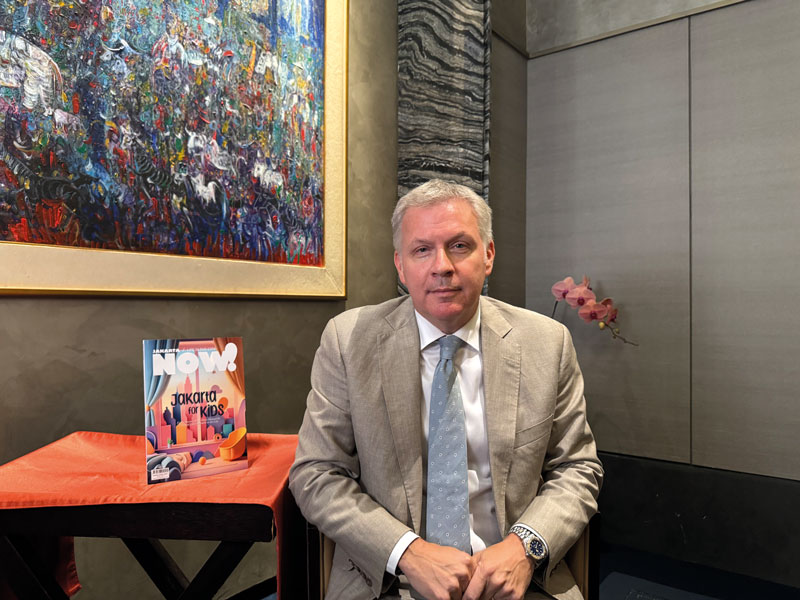
H.E. Mr. Marc Gerritsen (MG)
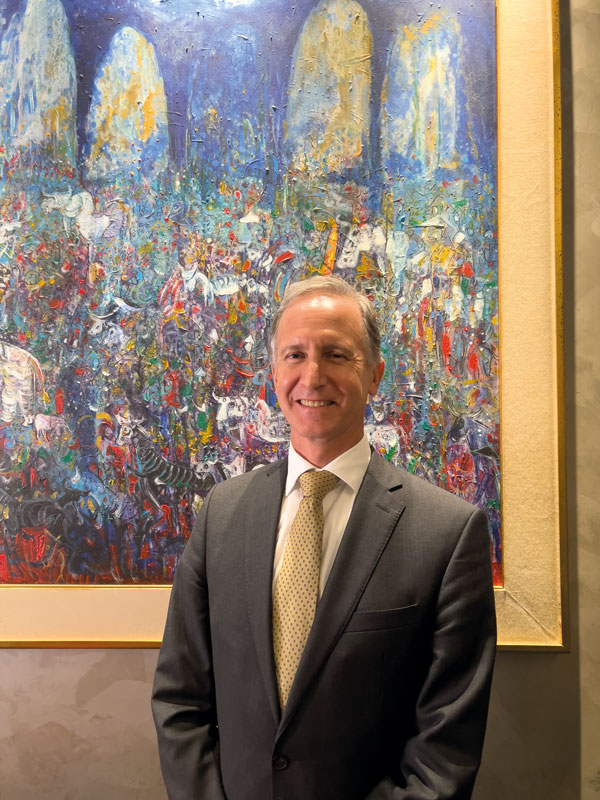
Marc Gerritsen is currently Ambassador of the Kingdom of the Netherlands to Indonesia, Timor-Leste and ASEAN, after being Director of the Middle East and North Africa Department, Ministry of Foreign Affairs of the Netherlands from 2021 to 2024.
He was Minister-Counsellor, Embassy of the Kingdom of the Netherlands in Tokyo, Japan from 2014 to 2017 and Deputy Director, Organizing Committee of the Nuclear Security Summit 2014, The Hague, The Netherlands 2012 – 2014. His extensive overseas career includes appointments in Rome and to the Palestinian Authority. He was also Advisor to the Prime Minister on International and European Affairs, Prime Minister’s Office, The Netherlands.
His impressive education record includes Clingendael Institute, Université de Paris IV Sorbonne, University of Groningen and Fulbright Program, Roosevelt University, Chicago.
H.E. Mr. Jess Dutton (JD)
Jess Dutton is the Ambassador of Canada to the Republic of Indonesia and the Democratic Republic of Timor-Leste, is a native of Montréal, Québec and has a Bachelor of Arts Honours and Master of Public Administration from Queen’s University in Kingston, Ontario.
He has worked with the Federal Government since 1998, starting as a Ministerial Advisor to the Minister of Canadian Heritage (Culture and Communications). In 2005, he joined the Department of Foreign Affairs and International Trade as Director of the division responsible for Intergovernmental Relations.
Over his long career he has worked in Seoul, Kandahar and Kabul in Afghanistan, and worked on the START Program in Ottawa.
In 2014, he was appointed Deputy High Commissioner to India, with accreditation to Nepal and the Kingdom of Bhutan before becoming the Ambassador of Canada to the Arab Republic of Egypt, in August 2017. He returned to Canada in 2020 as the Director General of the Middle East Bureau at Global Affairs Canada and was appointed as Canada’s Ambassador to the Republic of Indonesia, with accreditation to the Democratic Republic of Timor-Leste in 2023.
Highlight Interview Questions
AGS: What have been the high points in the relationship between your country and the Republic of Indonesia over the years? Were there any breakthrough moments that stand out?
MG: Choosing the most significant moments in the relationship between the Netherlands and Indonesia is no easy task – there’s so much to celebrate in our ongoing cooperation.
First a personal highlight: the presentation of my credentials to President Prabowo at Istana Merdeka. It was a true honour to meet him shortly after he had been inaugurated. After the beautiful ceremony, we had a short but in-depth conversation about Dutch Indonesian relations, both looking back – the President is an avid reader of history – and looking forward. We agreed there is a bright future our bilateral cooperation in fields such as food security, water management and renewable energy.
Secondly, I’d like to mention the recent repatriation of colonial collections from the Netherlands to Indonesia. I think this illustrates that our relationship has matured quite well. In total more than 800 artefacts have been returned so far, from Buddhist statues to Javanese keris daggers. And there is probably more to come. I had the privilege of meeting with Indonesia’s Minister of Culture, H.E. Mr. Fadli Zon, at the National Museum recently. We jointly inspected a batch of artworks that had just arrived from the Netherlands. It was a great moment, because it was clear to all of us that Indonesia is where these artefacts belong.
JD: Canada and Indonesia have enjoyed a robust and enduring partnership for over seven decades. Over the years, our relationship has grown steadily-founded on mutual respect, shared democratic values, and an alignment of our interests across many areas, from trade and investment to women’s empowerment and climate action.
Recently, we have seen a number of significant milestones in the relationship, particularly around the deepening of our economic partnership. A major highlight was the finalisation of the Indonesia-Canada Comprehensive Economic Partnership Agreement (ICA-CEPA). Canada’s then Minister of Trade Mary Ng and her counterpart Indonesia’s Trade Minister Budi Santoso marked the conclusion of the ICA-CEPA negotiation during a ceremony held in Jakarta in December 2024. The agreement is expected to be formally signed later this year and will significantly boost two-way trade as well as create new opportunities for both of our economies once it comes into effect.
We also had a successful Team Canada Trade Mission to Jakarta last December. Led by Minister Ng, the mission brought together more than 190 Canadian organizations – one of our largest business delegations ever in the region – reflecting our strong interest in expanding commercial partnerships with Indonesia in sectors ranging from clean technology and infrastructure to agri-food.
These are just a couple of examples that demonstrate the breadth and depth of our bilateral relationship and the enormous potential that lies ahead for both our countries.
AGS: What are the strongest elements in the relationship today? What are the factors and sectors that you are concentrating most on?
MG: Our countries are connected by countless personal ties. Around 2 million people in the Netherlands (more than 10 percent of the population) have a connection to Indonesia, through family ties or otherwise. And in Indonesia, there are roughly 25.000 Indonesian alumni of Dutch universities and institutes. These people-to-people contacts are a clear reference to the colonial past, which has also left a mark on both languages. Many words in Indonesian are also used in Dutch and the other way around, like gratis (free), kulkas (fridge), kantor (office), sepur (train). Then there’s the abundance of Indonesian restaurants in the Netherlands. The fusion of language, cuisine, and culture between the Netherlands and Indonesia is undoubtedly the strongest pillar in our relationship today, rooted in shared history.
Furthermore, I would point to the strong economic ties between our two countries. Indonesia is our gateway to doing business in Southeast Asia, and the Netherlands serves and the gateway for Indonesia in Europa. The Netherlands is by far the largest EU investor in Indonesia. And there is more to come: recently an agreement was signed between the Indonesian Ministry of Finance and the Dutch public-private financial institution, Invest International, paving the way for 300 million Euros worth of grants and loans to support President Prabowo’s priorities in funding sustainable public infrastructure with Dutch innovation and expertise in the sectors of water management, renewable energy, waste management, healthcare, and of course agriculture.
JD: The Canada-Indonesia relationship has actually had a very high point. Just last December, we had a large Team Canada trade mission to Indonesia. We had close to 200 Canadian companies and 300 Canadians seeking economic opportunities. Canada is a reliable and long-standing partner of Indonesia as it seeks to achieve its objectives of Golden Vision 2045, including achieving food security, energy security and the development of its human capital.
As it relates to food security, Canada is a secure supplier of agricultural products: we’re an important supplier of potash, which is important in fertilisers, and we’ll help Indonesia grow its agricultural sector. We’re working with farmers and others to help them grow more food, to make their operations more efficient and more sustainable. On energy security, Canada is investing hundreds of millions of dollars in Indonesia’s energy transition. We are an important source of cutting-edge technologies, whether it be in solar, hydro and of course, a safe and secure nuclear system. And as a leader in the extractive sector, we recently concluded an MOT on critical minerals with Indonesia, and that will help ensure that Indonesia is able to create the supply chains it needs an environmentally sustainable and safe way and of course, the development of human capital.
AGS: What about the future? Where do you want to take the relationship in the future?
MG: When it comes to the future, I might not be the best person to answer – my kids are in high school and in university, so they’ll be shaping it more than I will! Haha… But in all seriousness, I firmly believe the future of Dutch-Indonesian relations lies in the hands of today’s youth. It’s they who will bring fresh ideas and innovations to strengthen our partnership in the years to come. That’s why we are investing in scholarships and in our alumni networks, both those who have studied in the Netherlands and those who have studied in Indonesia. My hope is that these students return home with new ideas and innovations, ready to inspire the next generation of young Indonesians, especially women, to pursue more education – anytime, anywhere, and on any level. Education is the key to unlocking a brighter future for both our nations. But it is also about expressing your identity and having fun. At Erasmus Huis, the Dutch cultural center in Jakarta, we connect Dutch and Indonesian artists, musicians, performers photographers and designers. Follow us on Instagram for our cultural calendar.
Last but not least, I have a dream that hopefully will come true in the not-so-distant future. Wouldn’t it be great if both Timnas, Indonesia’s national football team, and Oranje, the Dutch team, will qualify for the 2026 World Cup. And – but now I am really pushing my luck – wouldn’t it be fantastic if both teams would play against each other on the world stage? If that happens, I will be the happiest diplomat there has ever been in Jakarta.
JD: Looking ahead, we want to build on the strong momentum we are currently seeing in the Canada-Indonesia relationship. Above all, we want to reiterate and solidify Canada’s position as an engaged, committed, and reliable partner of Indonesia, and in the region. We recognize Indonesia’s strategic importance as a growing middle power and dynamic economy. We welcome Indonesia’s voice globally. It should therefore come as no surprise that Indonesia is identified as a priority country under our Indo-Pacific Strategy, a once-in-a-generation shift in our foreign policy to bolster Canada’s presence in the region.
We look forward to continuing to actively support Indonesia in achieving its goals of food security, energy self-sufficiency, and its Golden Vision 2045. To do this, we are leveraging Canadian expertise in areas such as clean technology, green energy, and sustainable agriculture. Through partnerships between our education institutions and continued investments in women’s health and empowerment, we are contributing to the development of Indonesia’s human capital needed to become an advanced economy by 2045.
Through our development cooperation, we will support Indonesia in its journey to achieving the 2030 Sustainable Development Goals, focusing on gender equality and the empowerment of women and girls, as well as climate change resilience and environmental sustainability—areas where Canada already has a strong history of engagement in Indonesia.
Signing and implementing our Comprehensive Economic Partnership Agreement is a key priority for Canada and Indonesia this year. The agreement will remove barriers to trade and bring enormous economic benefits for both of our countries. Beyond two-way trade, Canada fully supports Indonesia’s economic integration, including through the Comprehensive and Progressive Agreement for Trans-Pacific Partnership (CPTPP) and accession to the OECD.
The future of the Canada-Indonesia relationship is bright and full of potential and promise. Our future relationship will continue to be centered on collaboration—as close partners—addressing both domestic and global challenges