


Once a colonial hotel, later Duta Merlin, and now part of an MRT-linked future, this Harmoni site has moved through several urban afterlives
It is not an exaggeration to say that at Harmoni, one stretch of ground has carried more than one city upon it. For much of the nineteenth and twentieth centuries, that ground was best known as the site of Hotel des Indes, among Batavia’s most prominent hotels and now one of the capital’s most historically charged addresses.
Long before Duta Merlin stood on the site, this particular area on Jalan Gajah Mada had already lived through several names and functions. It began as Hotel de Provence in 1827, became Hotel Rotterdam in 1851, and took the name Hotel des Indes in 1856, which later changed to Hotel Duta Indonesia in post-independence era.
That earlier 1827 date is worth stressing, because the story of the site later known as Hotel des Indes is often said to begin in 1829, when Antoine Chaulan is believed to have bought the property. Yet a notice published in the Bataviasche Courant on 12 April 1827 shows Chaulan already announcing that he would open a hotel called Hotel de Provence on 1 May at the house recently occupied by a Mr Adisson on Molenvliet, now Jalan Hayam Wuruk and Jalan Gajah Mada. This suggests that Chaulan had already acquired the property and converted it into a hotel two years earlier than the initial assumption.
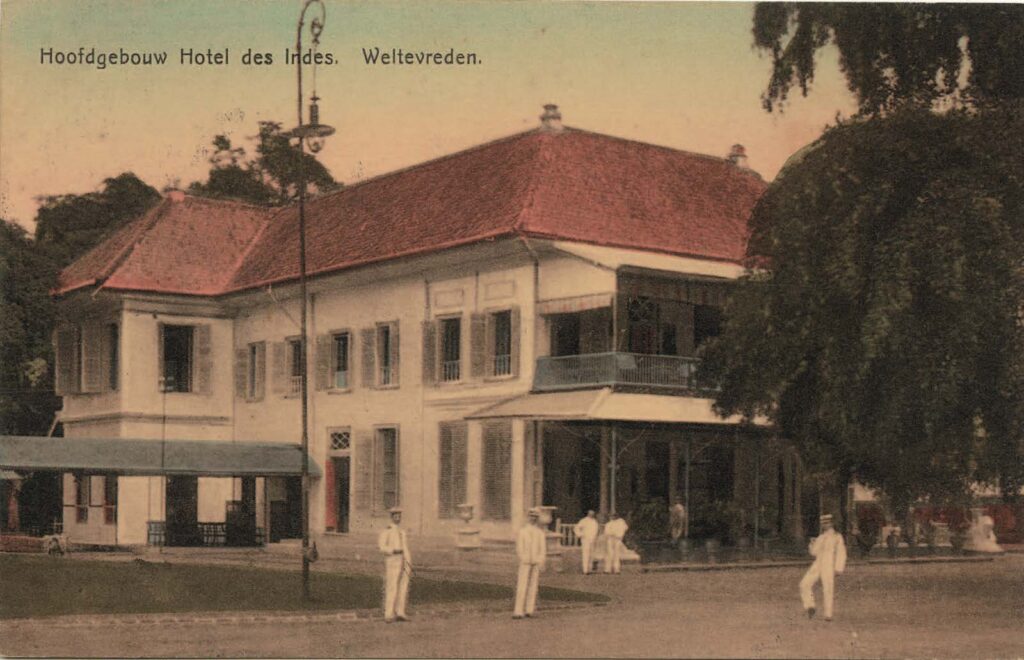
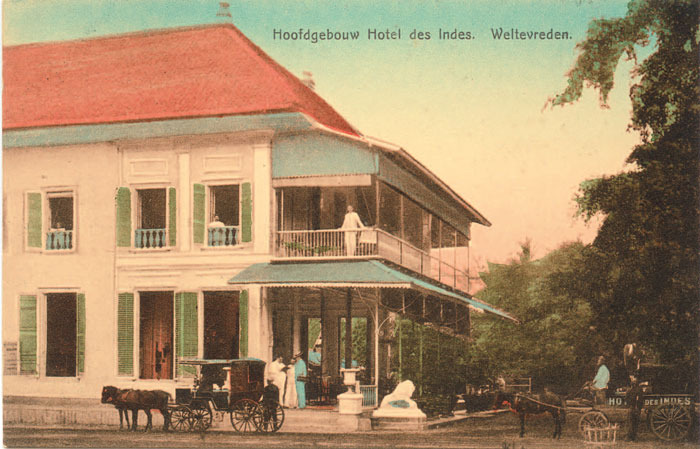
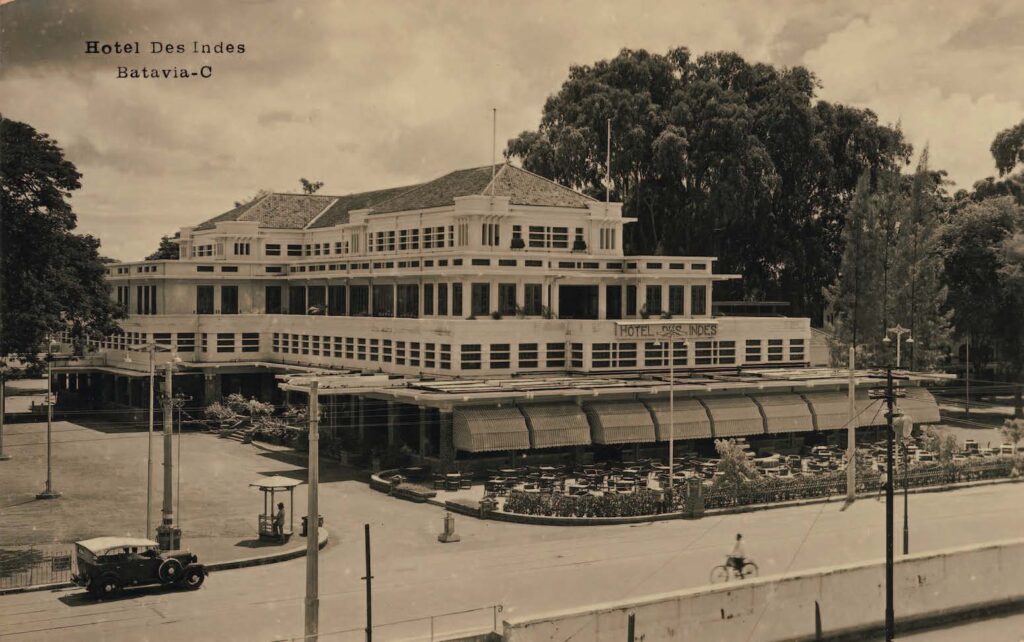
showing a glimpse of Batavia’s nineteenth century hotel life, postcard
published by Visser & Co., c. 1910
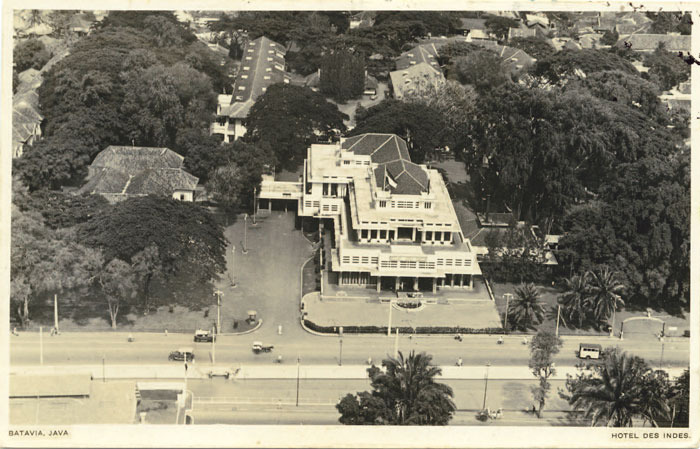
The hotel occupied an extensive 6.5 hectare site. Its original buildings were cleared in 1971, and later redevelopment introduced the Duta Merlin complex on part of this historic ground. In 2023, demolition took place on part of the late complex as MRT Jakarta redevelopment plans moved forwards.
Perhaps the site’s succession of names is part of what makes its story so interesting, and so revealing. Each change marked a different phase in the life of the property. One account holds that Eduard Douwes Dekker, better known by his pen name Multatuli, urged the owners to abandon Hotel Rotterdam in favour of something more French and more appealing. Once it became Hotel des Indes, the site entered a far more stable and recognisable chapter. By the late nineteenth century, it had become one of Batavia’s best-known addresses.
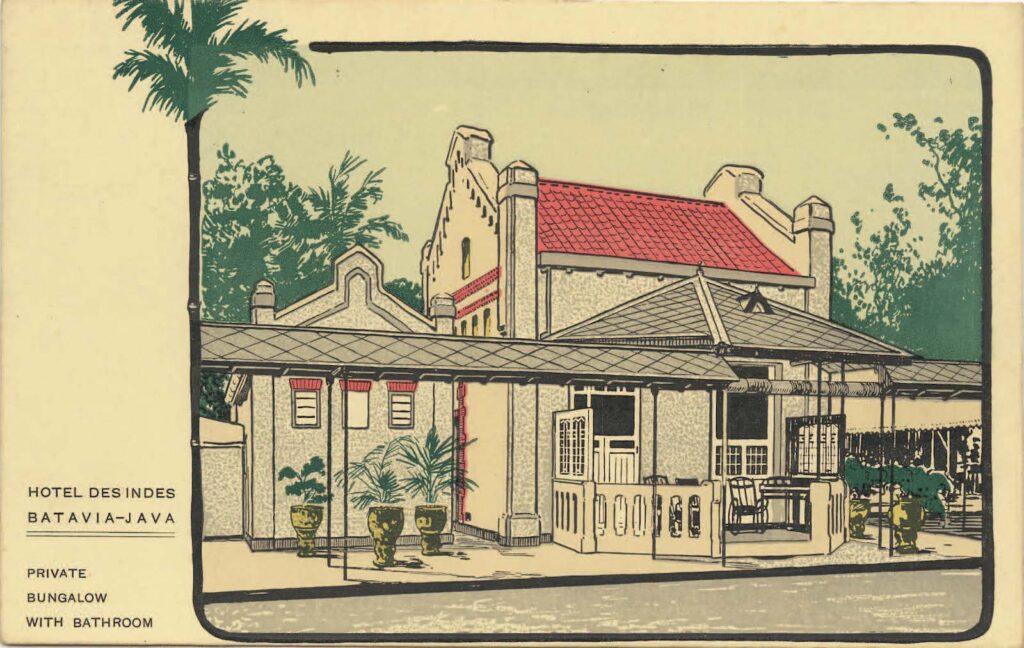
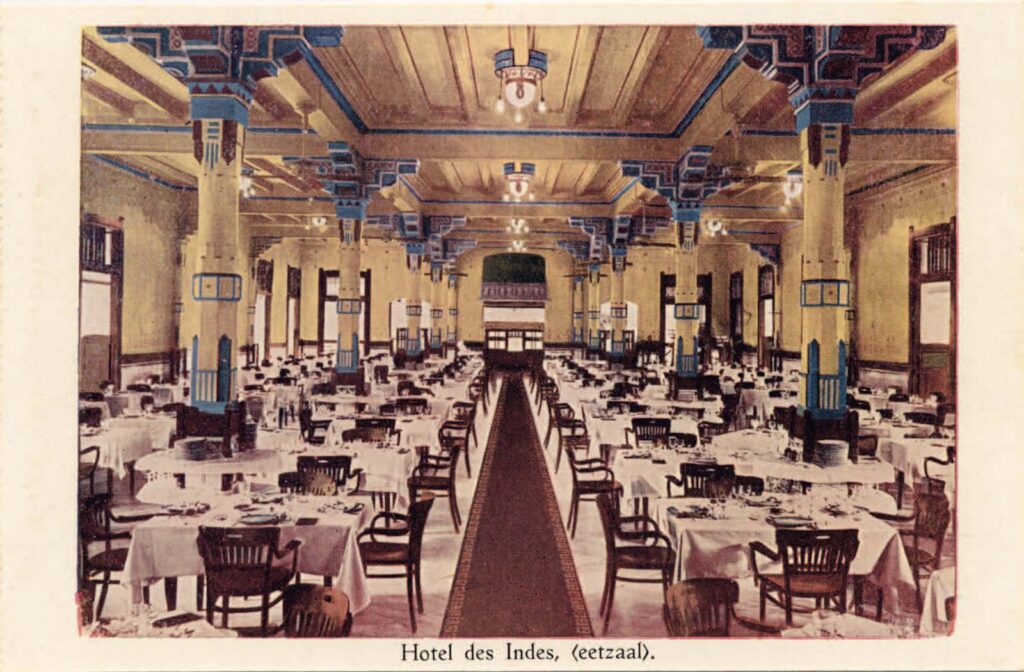
For more than a century, Hotel des Indes remained part of Batavia’s, and later Jakarta’s, urban identity. Travellers arriving from the port were brought inland along Molenvliet to a hotel known for its grand scale, verandas, and service. Alfred Russel Wallace, a leading nineteenth-century naturalist and the figure behind the Wallace Line, described “rooms opening onto a veranda, marble baths, and meals served at fixed hours“. Other records speak of its lavish rijsttafel that wass served with elaborate ceremony.
Its later architectural form gave the hotel an even stronger place in Batavia’s visual memory. In 1930, a magnificent new main building in the Art Deco style was opened, turning the site into a defining landmark of the capital. For several decades, from the 1930s into the 1960s, it stood among Jakarta’s well-known buildings. Seen in postcards and period images, it represented the prestige of the hotel and a version of the city that has largely disappeared.
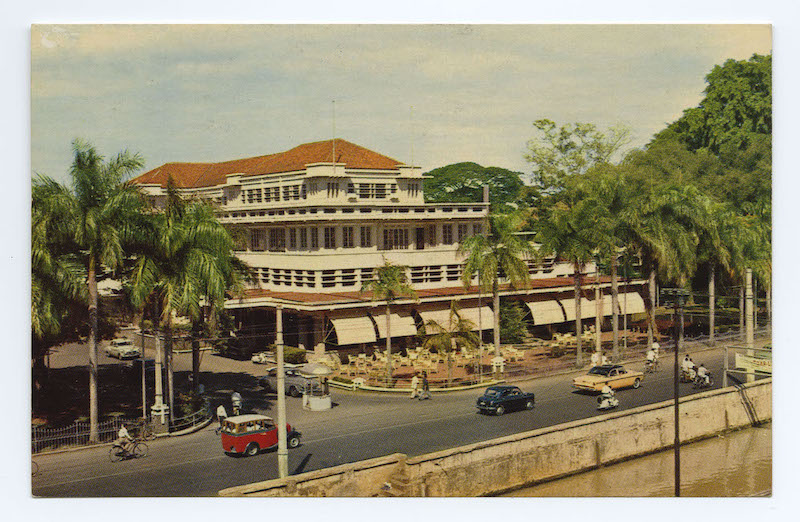
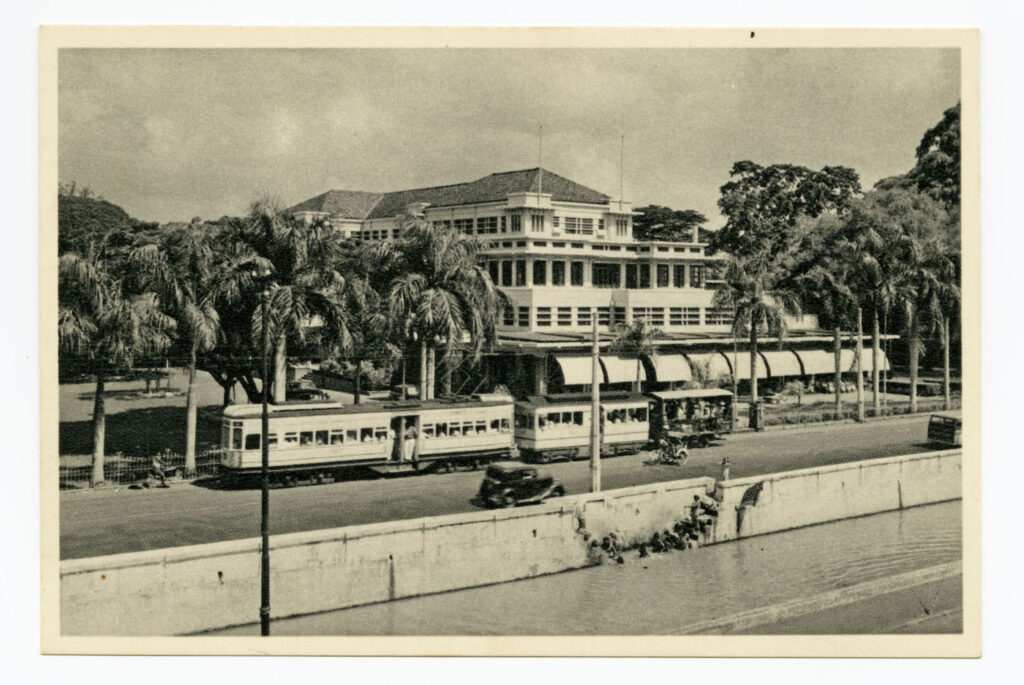
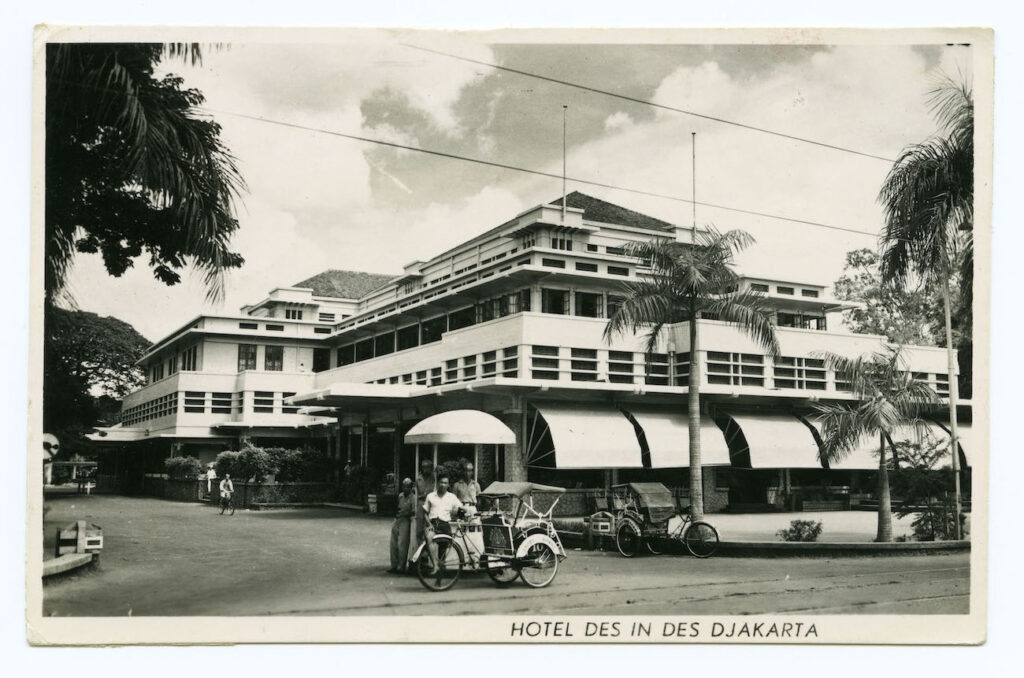
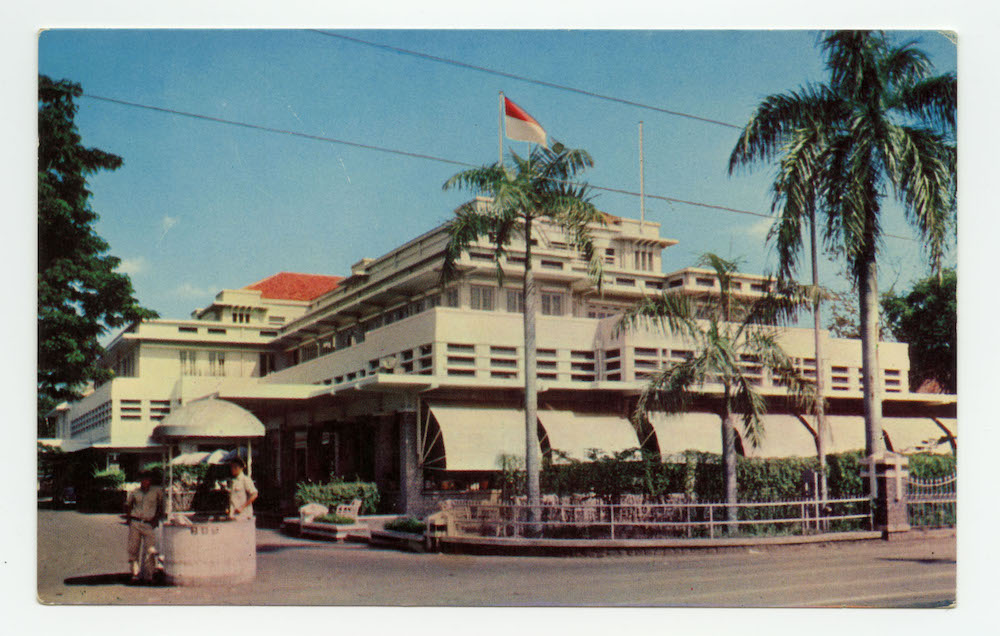
Its importance extended well beyond accommodation. In the government hotel rankings published by the Office for Price Control in March 1951, Hotel des Indes was the only category “A” hotel in Jakarta, reflecting both its standing and the government’s apparent recognition of a serious shortage of hotel rooms in the city. The hotel entered national history in 1949, when the Roem–van Roijen Agreement was concluded there. In 1955, it also hosted heads of state attending the Asia-Africa Conference, even though the conference itself took place in Bandung.
In the early years of independence, it remained active in elite social life, though the meaning of the space had changed. It was no longer simply a colonial hotel. It was being folded, awkwardly at times, into the life of a new capital. That transition became explicit when the hotel took the name Hotel Duta Indonesia, part of a broader effort to remove colonial associations from public places.
Yet the change did not restore its relevance. With Hotel Indonesia opening on Jalan Thamrin in 1962, Jakarta’s prestige was moving south. Decline followed. By the mid-1970s, Duta Merlin had emerged on the site as a reduced version of a far larger redevelopment plan.
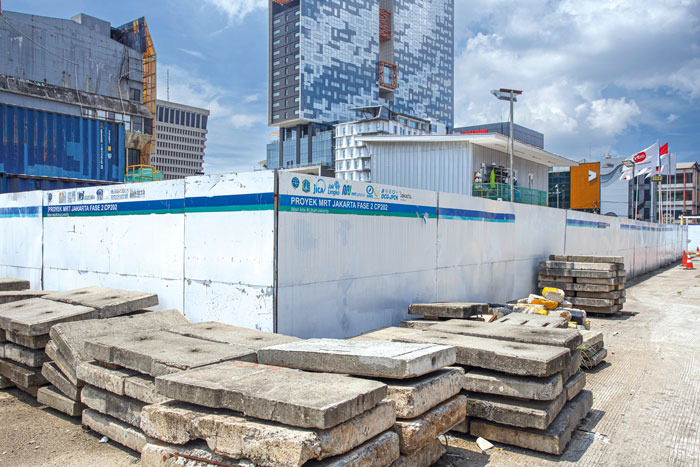
That replacement has never been easy to read in one way. Hotel des Indes had been a colonial address, and for much of its life access to such spaces was restricted to a narrow social class. Its removal could therefore be read as part of an effort to clear away a symbol that had little place in an independent city. At the same time, the 1970s were years of aggressive commercial expansion in Jakarta, and prominent land in Harmoni was too valuable to leave untouched.
Duta Merlin developed a long afterlife of its own, persisting the decades through retail and commercial tenants, ownership disputes, and unmet promises. Following the 2023 demolition of parts of the complex, the site is now being prepared for transport-oriented redevelopment linked to MRT Jakarta. A place once reserved for colonial privilege, then remade for commercial ambition, is now being recast for transport and public access.
Read our other Time Capsule articles:
Societeit de Harmonie | Metropole Cinema | Istiqlal Mosque
Sources:
Gelink, J.M.B. 50 Jaar N.V. Hotel des Indes Batavia. De Unie, 1948. OCLC 63858916. ISBN 978-1-00-000366-6.
Merrillees, Scott. Jakarta Postcards of a Capital, 1900–1950. Hanusz Publishing LLC, 2014.
Merrillees, Scott. Jakarta: Portraits of a Capital 1950–1980. Singapore: Equinox Publishing, 2015.
Bataviasche Courant. “Hotel de Provence.” Advertisement by Antoine Chaulan. Batavia, 12 April 1827. Retrieved via Delpher.nl.
National Geographic Indonesia. “Hotel des Indes: Dari Multatuli, Wallace, Sampai Tempat Bunuh Diri.”
Berita Senator. “Duta Merlin Tinggal Kenangan.”