


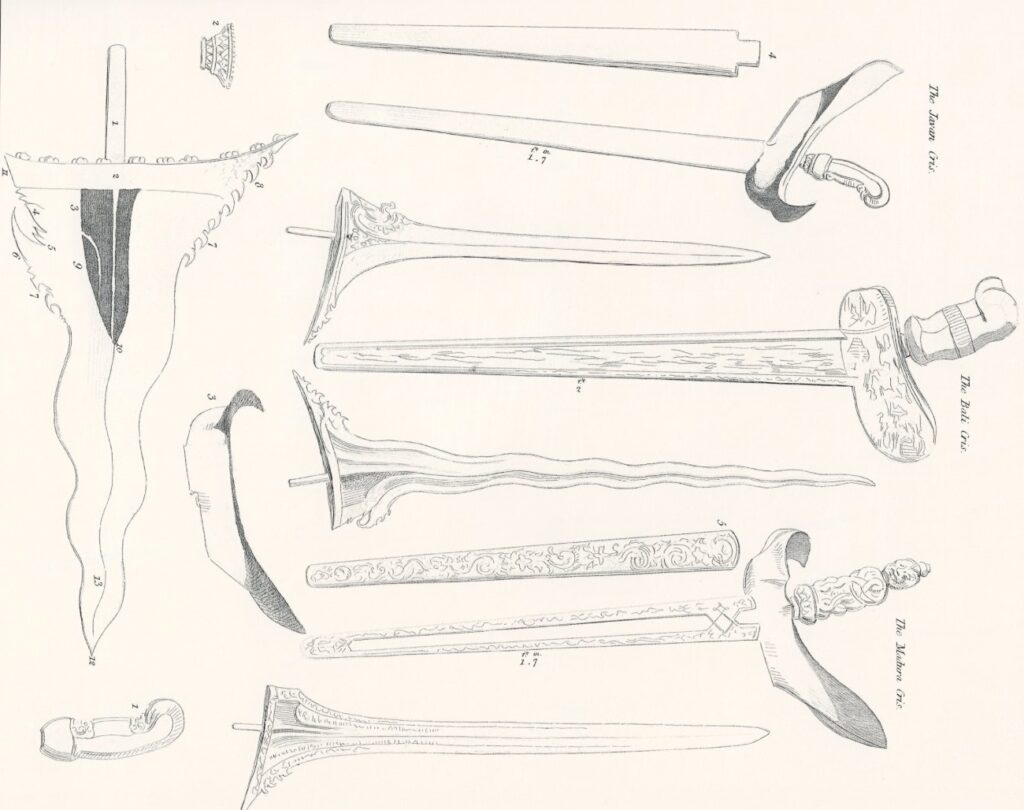
This 1817 print from Sir Thomas Stamford Raffles’ The History of Java details the keris’ components, showcasing its key elements — including the iconic curved blade. The keris’ curved, slithering shape is linked to the Naga, the snake-like deity from Indian mythology. It symbolises irrigation canals, rivers, springs, wells, spouts, waterfalls, and rainbows; thus, the wavy blade symbolises the serpent’s movement. (Sake Santema Collection)
Few objects capture Indonesia’s rich heritage like the keris. Distinctive to Java and Bali, this dagger is more than a weapon — it is a ceremonial cultural symbol. Keris are used in many different respects: as weapons, as talismans with magical powers, as sanctified heirlooms, as equipment for court soldiers, as an accessory for ceremonial dress, as a symbol of heroism, as an indicator of social status, or simply to display their beauty. In this article, Sake Santema from Indies Gallery presents some of his antique keris prints alongside a brief history of their origins, evolution, and modern-day significance.
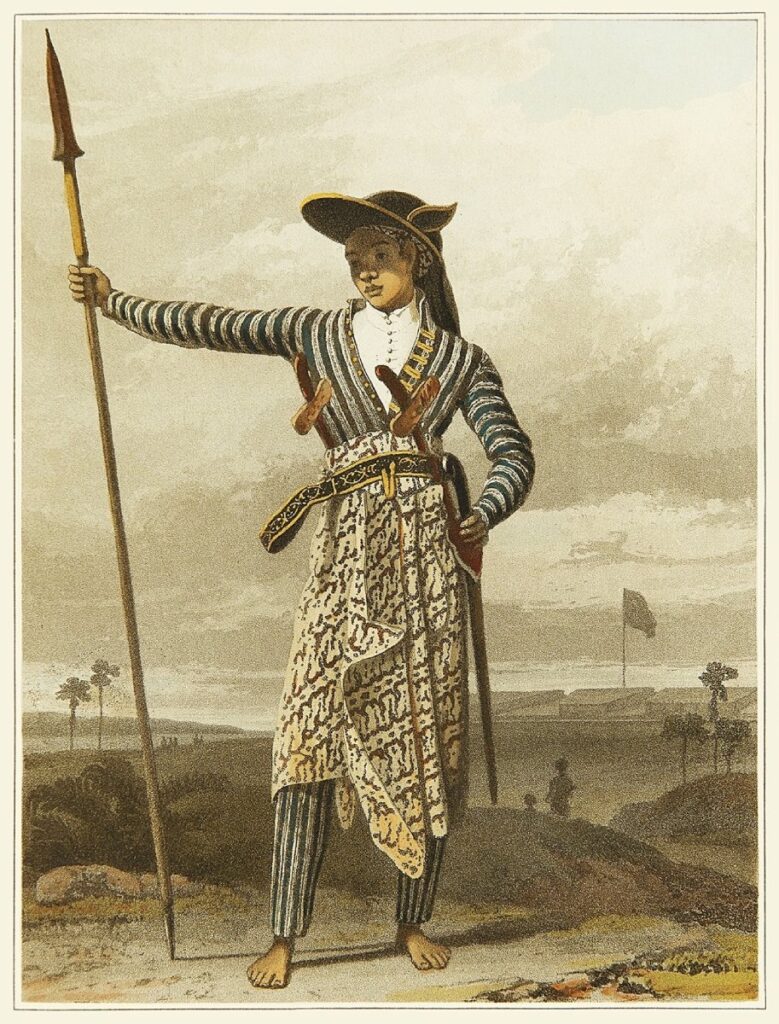
A Javanese warrior wearing two keris, from Sir Thomas Stamford Raffles’ The History of Java, first published in 1817. In its earliest forms, the keris was a practical weapon used in close combat and was carried by warriors as an accompaniment to their main weapon, usually a spear. (Sake Santema Collection)
The keris has its roots in 9th-century Java, as seen in Prambanan and Borobudur temple carvings. Evolving from straight-bladed daggers, it probably adopted its iconic wavy blade form during the Majapahit period between the 10th and 14th centuries — some say inspired by Vietnam’s Dong-Son daggers (300 BC). The keris can be divided into three parts: blade (bilah or wilah), hilt (hulu), and sheath (warangka). The word keris originates from Old Javanese, likely derived from the term ngiris (or iris), which means “to slice,” “to wedge,” or “to sliver.”
Whilst hilts and sheaths may be crafted from rare woods, rhino ivory, or fossilised elephant teeth and adorned with gold, silver, and fine gemstones, the blade is the keris’ most sacred part. The sheath keeps the dagger’s forces in check whilst protecting the blade. Blades always have odd-numbered waves, which are considered auspicious in Javanese tradition. Some are forged from extraordinary materials — astral iron from a meteorite that fell near Prambanan 200 years ago, or even scrap from Second World War aircraft. Forging is steeped in ritual, with smiths, or empu, revered as both skilled artisans and spiritual practitioners who invoke blessings and imbue blades with mystical properties. High-quality keris blades are worked hundreds of times and can take years to complete. In earlier times, they were said to be infused with poison during forging, making any wound fatal.
For commoners, the keris was a daily accessory — especially when travelling — serving as a practical tool for self-defence. In peacetime, it was worn mostly as part of ceremonial attire, typically at the back, possibly influenced by early Portuguese custom. During the Majapahit era (13th–16th centuries), the keris rose to prominence in Javanese courts and among the aristocracy, evolving from weapon to spiritual object imbued with mystical powers.
Keris are seen as almost alive: vessels of spirits, good or evil. Legends tell of blades that move on their own, kill at will, stand upright when their masters call their true names, or even render their owners invisible in danger. They were said to prevent fires, death, and crop failure, or bring fortune such as bountiful harvests. If an owner slept with the blade under their pillow, the keris’ spirit would communicate through dreams.
Harmony between weapon and owner is critical. The keris was often passed down as a family heirloom, or pusaka, believed to house ancestral spirits. The annual Javanese cleansing ritual jamasan purifies the keris, enhances its power, and maintains its link to the ancestors. In Bali, heirloom keris are honoured every 210 days on Tumpek Landep, meaning “sharp.” They are cleaned, displayed in temple shrines, and offered incense, holy water, red food, and flowers to Brahma, the god of fire.
Islam’s spread in the 15th century brought new motifs to the keris. Earlier blades featured Hindu-Buddhist symbols; later ones incorporated Islamic calligraphy and iconography. The keris declined as a battle weapon after European firearms arrived in the 16th century, then faded further when the Dutch East Indies banned edged weapons in the early 20th century.
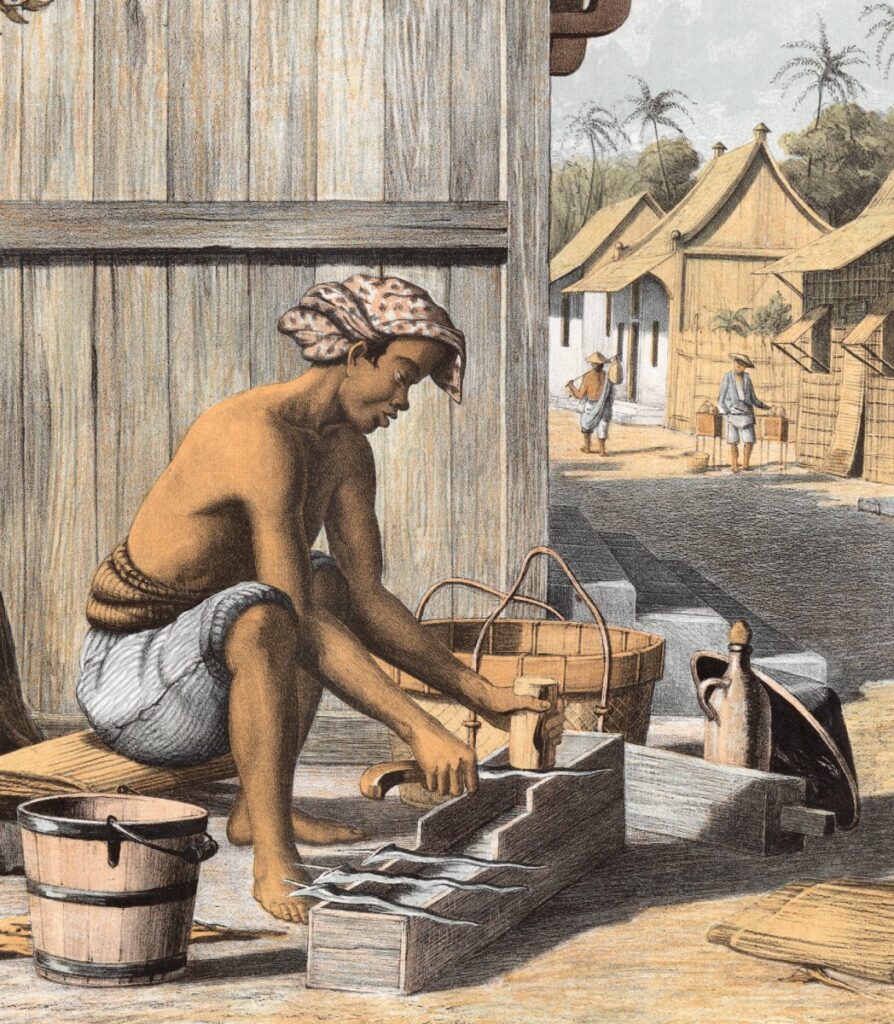
This 1853 print shows a Javanese man sharpening keris blades on the street in Batavia. Kerises often broke and needed repairs, so it isn’t unusual to find one with fittings from several regions — a blade from Java, a handle from Bali, and a sheath from Madura, for example. (Sake Santema Collection)
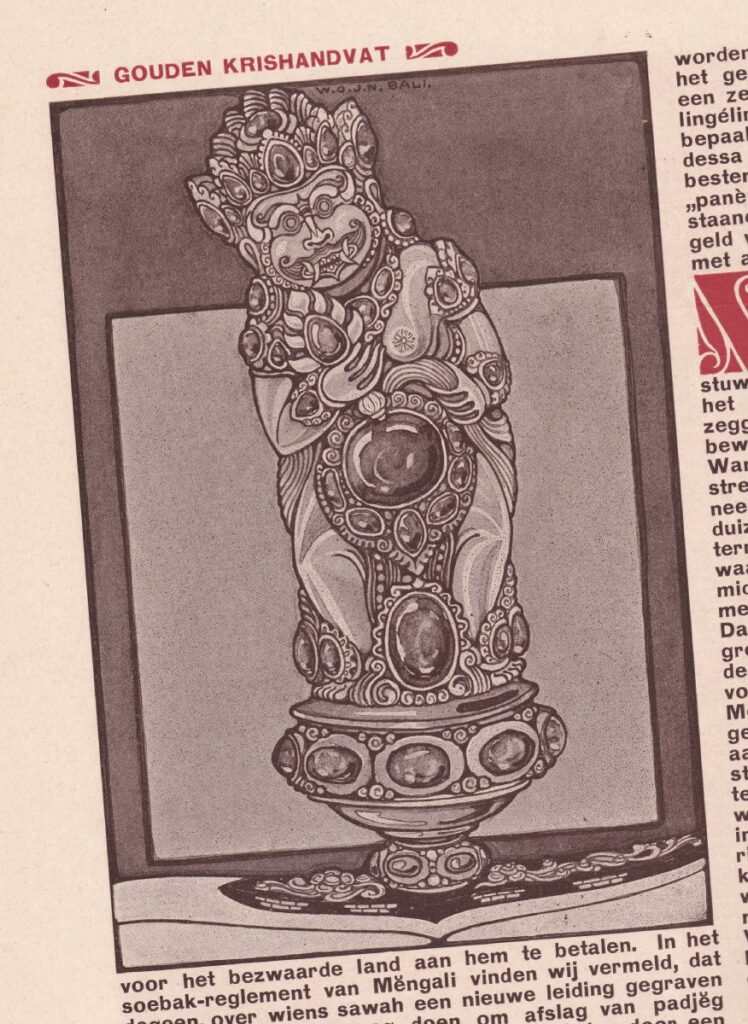
This sketch of a richly decorated Balinese keris hilt is by Dutch artist W. O. J. Nieuwenkamp, known as the first European artist to arrive in Bali in 1904. Figural keris hilts are especially tied to Bali, where Hindu art traditions continued uninterrupted despite Islam’s influence across Indonesia. (Sake Santema Collection)
In 2005, UNESCO recognised the keris as a Masterpiece of the Oral and Intangible Heritage of Humanity. Across Indonesia, the keris continues to be a focal point in ceremonies, rituals, and traditional performances. It remains an integral part of weddings, where it symbolises the groom’s readiness and responsibility, and is featured in wayang (shadow puppet) theatre, dance, and processions. Beyond its ceremonial role, the keris is a marker of identity and heritage. Many families still possess heirloom keris, passed down as treasured pusaka. Collectors and enthusiasts continue to value the artistry and historical significance of antique keris, whilst contemporary smiths keep the tradition alive by forging new blades using time-honoured techniques.
The prints in this article are available for purchase through Indies Gallery, whilst high-quality reprints can be found at Old East Indies.
Indies Gallery & Old East Indies
Jl. Gambuh No. 17, Denpasar, Bali
www.indiesgallery.com